Category: science kits

Saturday, 21 January 2012

14:13 – I should have known better. Barbara and I had dinner out last night and then headed to the supermarket. My total haul consisted of one small carrot. Searching the web turned up results that said the local Lowes had packages of eight 8.75 gram yeast packets for $0.59. They did have yeast packets for $0.59, but that was for one 8.75 gram packet, not eight. Similarly, although the web search said the local Lowes had unflavored gelatin in one-pound packages for a reasonable price, all I could find was one-ounce packages for something like $2.99 each. Both of those prices were outrageous. I’ll just order the gelatin and yeast by the pound or kilo on-line.

Barbara is working on biology kits today, while she watches the Wake Forest game. She’s labeling and packaging stuff that’s stable and can be packed ahead of time, like lima bean seeds, dextrose, agar, and so on. We needed to change from the 5162 labels to 5160 labels because the 5162’s are too tall to fit the wide-mouth pharma packer bottles we’re using for solids. The 5160’s come 30 per sheet. We decided that 30 kits wasn’t enough initial inventory, so we’re doing 60 of everything. That should strike a happy balance between finished goods inventory cost and cubic, freshness of the kits, and fast availability.

When the book comes out in April, we’ll probably end up with a flood of orders, followed by another flood in time for the autumn semester. We’re going to try to keep a 3-week inventory of finished kits on hand. That number will vary by time of year, of course. At peak times, we may be shipping 20 or more kits a week. At slower times, we may be shipping only a few a week. But three weeks gives me time to order components, make up and package chemicals, and so on.


Read the comments: 1 Comments

Friday, 20 January 2012

10:14 – I’ll finish my final pre-editing pass on the lab sessions today and get them off to the reviewers. At that point, I jump back into the early narrative chapters to do clean-up and rewrite. I should finish that in the next few days. I also have a dozen or so images left to be shot, which I’ll do this weekend. So, for the next ten days or so, I’ll be busier than the proverbial one-armed paper hanger, incorporating edits and comments from reviewers and getting the manuscript ready to go to production on 31 January.

I was about to order gelatin and yeast on-line, until I realized that it’d be cheaper and faster just to make a visit to the supermarket. Sure enough, the local Lowes Foods has yeast for $0.59 for eight packets of 8.75 grams each, so I’ll just buy enough of those to make the first batch of kits. Same thing for gelatin, cheap and readily available. I’ll just buy a couple pounds of unflavored gelatin and repackage it for the kits.


12:52 – I’m uploading the last of the lab session chapters to the server right now. That takes a while, given that Time-Warner caps upload speeds around 125 KB/s (still an improvement over the 45 to 50 KB/s we got until a few months ago) and some of these chapter directories are rather large. Even with thumbnailed images, some of the chapters are 10 to 15 MB, and the scores of high-res images tend to add up. I think this batch totals something like 1.5 GB.

I’m going to reward myself by taking a ten-minute break and then jump back into the early narrative matter. Most of that doesn’t require tech review, so I wanted to get the lab session chapters available first to the reviewers.

I’m in my usual worry mode now. For some reason, I always think that the material I’ve submitted is going to end up after formatting and lay-out as a 30-page pamphlet or something. Of course, that’s ridiculous. No book I’ve ever written has come in under the allotted page count, and some have been significantly larger. Oh, well. I covered what I wanted to cover, and soon it’ll be on to building biology kits and starting on the re-write of the forensics book. I already have an idea for a lab session I want to add to that, but I’ll have to do some experiments to see if it’s practical. (Hint: it involves raw meat and flies.)

Read the comments: 24 Comments

Thursday, 19 January 2012

08:46 – I’m in heads-down mode on the biology book chapters, doing a final pass on them and sending off several a day to the editors. I’m also updating and annotating the bill of materials for the biology kits as I go along.

Some of the BoM changes are pretty trivial. For example, we’ll use ordinary unflavored gelatin in a couple of lab sessions. Until now, I’d included gelatin in the You-Provide list, but yesterday I decided to make it an Included-in-the-kit item. It’s certainly no real hardship to have kit purchasers buy a pack of unflavored gelatin at the supermarket, but including it means there’s just one less thing for them to worry about.

Other BoM changes have implications. For example, one of the lab sessions involves growing lima beans with and without Rhizobium, which is a nitrogen-fixing bacteria, and then comparing growth in the test specimens grown with and without nitrogen. That’s an interesting experiment, but the problem is that I can ship kits with the Rhizobium to 49 states, but not Hawaii. (Apparently, Hawaii is worried about a pestilence of nitrogen-fixing bacteria.) So, I had to update the BoM to make two kit versions, one for Hawaii and one for the other 49 states. That raises the issue of what Hawaii residents should do for this lab session. I decided to include a bottle of ammonium nitrate with only those kits shipping to Hawaii. Geez.


Read the comments: 30 Comments

Wednesday, 18 January 2012

09:35 – I was going to black out this site today in sympathy with the SOPA/PIPA protests, but I couldn’t figure out how to turn the whole page black. If SOPA/PIPA does pass, I’ll have to make some changes around here, starting with disabling comments.


I’m still cranking away on my final pre-editing pass of the lab sessions. There are quite a few missing images, which I’m just putting in placeholders for for now. I created a to-be-shot images list, and I’ll go through and shoot those in a batch.


USPS introduces a new regional-rate box today, to join the current RR Boxes A and B. The new RR C box is considerably larger—12x12x15” (30.5×30.5x38cm)—and might actually have been useful had the USPS not priced it ridiculously high.

The smallest RR box, A, requires postage at the Priority Mail 2-pound level, and can be used for up to 15 pounds. The mid-size RR box, B, which is what I use for kits, requires postage at the Priority Mail 4-pound level, which means it costs me $5.81 in postage for relatively nearby destinations up to $14.62 for zone 8 (the west coast, Hawaii, and Alaska). It can be used for up to 20 pounds. The new RR Box C is priced at the Priority Mail 17-pound level, which means it would cost almost $15 to send to nearby destinations and about $45 to send to zone 8. It can be used for up to 25 pounds. That’s not a very good deal, considering that the large flat-rate PM box (12x12x5.5”, up to 70 pounds) costs only about $15 to send to any address in the US, including zone 8.

There’s a lot of discussion about this new box on the forums frequented by eBay sellers and other vendors. Many people thought the 17-pound rate was a typo, and that USPS really meant to say the 7-pound rate. That might have been reasonable, but as it turns out they really did mean the 17-pound rate. In effect, the USPS has made this new box useless other than for a very small percentage of shipments: those that weigh between 18 and 25 pounds, are too large to fit a large flat-rate box, and are going to distant addresses. Otherwise, it’s cheaper to use UPS or FedEx. Sometimes far cheaper.

If USPS had been smart, they’d have made the RR box C a 12x12x10” box with a 25-pound limit and priced it at the PM 7-pound rate. That box would have been very useful and very widely used. But a RR box C that costs from $14+ to $45 is simply a non-starter.


Read the comments: 35 Comments

Tuesday, 17 January 2012

08:11 – I just mailed off the state and federal estimated tax payments. Government should be just like any other product. If you want it, you pay for it voluntarily. If you don’t, you don’t.

I spent yesterday working on the front matter for the biology book and also on rewrite on the first group of lab sessions. I just re-worked one of those, on antibiotic sensitivity of bacteria, yet again. This is the third time, so let’s hope it’s a charm. In the first iteration, I based the lab session around antibiotic test papers, which is the usual method of testing sensitivity of bacteria to different antibiotics.

The problem with that was that I wanted to do a follow-up procedure in which we retested the now-resistant bacteria against the various antibiotics. That required re-culturing the bacteria in the presence of an antibiotic, which really meant I needed to supply the antibiotics in more concentrated form. So, several weeks ago, I rewrote that procedure to use solutions of the antibiotics rather than impregnated test papers, and respecified the kit contents accordingly.

The problem with that method is that it turns out that dilute solutions of some of the antibiotics I used are not stable in dilute solutions, even when refrigerated. So, yesterday I re-rewrote that procedure around different antibiotics, one of which I can supply with the kits in liquid form, one as capsules, and two as powders, all of which are stable.

That, of course, meant that I had to track down sources for the materials, put together purchase orders, and actually order the materials for the first batch of kits. Not to mention creating new labels for those components and creating new MSDS sheets for each. I’ve now done all that (other than the MSDSs), and updated the bill-of-materials for the kits.


14:12 – Wow. I just took a break to do a backup, and while the backup is copying to the thumb drives I was checking news sites. It appears that that Italian cruise-ship company has hit the rocks in more ways than one. The ship itself is a write-off, and I suspect the insurers will balk at paying a third of a billion dollars to replace the ship, given that the captain acted completely irresponsibly. I understand that he knowingly approached the rocks to get close enough to shore that his head cook could wave to a family member. Then the captain bailed at his first opportunity. The hell with his passengers, he was out to save himself. And now I see that the company has left the shipwrecked passengers stranded, literally. Most of the passengers lost all of their possessions, including passports, credit cards, and cash. Not to mention things like prescription medications. Ordinarily in a situation like this, one would expect the company to fall all over itself to help the people it dumped into the ocean. Buy them clothing and personal items to tide them over. Intercede to help them get temporary papers or replacement passports. Pay airfare to get them back home. And so on. Apparently, this company is doing literally nothing to help, not so much as buying the victims a cup of coffee. Victims who’ve asked for help have been told to sue the company. It’s not that the company is trying to avoid admitting responsibility. They’ve already done that. They’re just not willing to spend a cent to help the victims. Apparently, the captain was not the only miserable excuse for a human being employed by this company.

Read the comments: 42 Comments

Sunday, 15 January 2012

12:00 – I’m still cranking away on the final lab session, which I should finish up today or tomorrow.

Barbara disassembled 600 15 mL dropper bottles yesterday, which means unscrewing and removing the cap and then pulling the dropper tip plug. That’s a lot of work that wouldn’t be necessary if our supplier shipped those bottles already disassembled. These are Chinese-made bottles, and the supplier says they’re shipped that way to save shipping costs. I suggested that since bottles must be disassembled to fill them, they might want to package the bottles, caps, and dropper tips separately, even if that raised the price a bit.

Before I ordered these bottles, I seriously considered buying the equivalent bottles from one of my other suppliers. Those bottles are US-made and cost about 25% more than the Chinese bottles. Although the cost of bottles is not an insignificant percentage of component costs, the extra cost of the US-made bottles wasn’t really the deciding factor. Other than having to disassemble them, I actually prefer the Chinese bottles. The body of their dropper tips is about two or three times longer than the body of the US-made dropper tips. The Chinese tips are a tight friction fit in the mouth of the bottle, while the much shorter US tips are a snap fit. To me, the Chinese tips seem more secure. I’m afraid that if I use the US bottles someone will squeeze a bottle too enthusiastically and pop out the dropper tip. That wouldn’t be good, particularly if the bottle contained a concentrated acid, strong ammonia, or a similar chemical. So for now I’m sticking with the Chinese bottles and hoping I can convince my supplier to package the bottles, caps, and tips separately.


Read the comments: 5 Comments

Friday, 13 January 2012

08:06 – Friday the 13th falls on a Friday this month…


FexEx showed up yesterday with a couple thousand polyethylene dropper bottles, 100 dozen 15 mL, 50 dozen 30 mL, and 20 dozen 125 mL. With what I already have on hand, that’s sufficient for the first batch of 56 biology kits. We’re still debating how many biology kits to stock pending publication of the biology lab book. We want to strike a balance among timely delivery, working capital allocated to inventory, storage space for finished-goods inventory, and freshness of the kits. I have second sources (and usually third and fourth sources) for all of the components, so back-ordered components shouldn’t be a problem. Working all-hands-on-deck, we can probably build and ship 100 kits a week, so if there’s a real flood of initial orders we should be able to keep up with only short shipment delays. I hope.


Work continues on the final lab session. I’d planned to finish it today, but it looks like that’s not going to happen. I should be able to finish it over the weekend.

One of the first things on my to-do list after I get this book complete is to upgrade my main office system. I am running, believe it or not, Ubuntu 9.04. It’s just short of three years old, and even security updates were discontinued long ago.

The problem was again made evident yesterday. My Epson V300 scanner arrived on Wednesday, so yesterday when I decided to take a break I figured I’d set it up and see if it worked. It didn’t, of course. It required newer versions of some system utilities, and those simply aren’t available for Ubuntu 9.04.

So, come 1 February, I’m going to back up all my stuff, pull the current system drive, pop in a new 3 TB Barracuda, and install a current Linux. The question is, which one. I’m pretty sure I don’t want to install the current Ubuntu, which by all accounts has completely gone off the rails. I’m thinking about installing the current Kubuntu, but I’m certainly willing to consider alternatives. What I want is a good desktop Linux, ideally one that’ll recognize my scanner and other stuff automagically and Just Work. Same deal on stuff like networking my system to Barbara’s and the den system. So, which is the best desktop Linux out there?


14:19 – Oh, boy. S&P is getting ready to downgrade the sovereign debt ratings of France and Austria. For Austria, no longer being AAA will be annoying but not critical, at least for the moment. For France, losing its AAA rating is catastrophic. France now officially joins the rest of Club Med. And the FANG nations are now the FNG nations.

Read the comments: 37 Comments

Sunday, 8 January 2012

07:44 – This will probably be my last post for a while, and one of few I’ll make between now and my drop-dead book deadline on 31 January.

I thought this comment, which was posted yesterday, deserved more of a response than I could give it in the comments section.

RBT, I have a couple questions relating to your home science books. I don’t recall seeing them asked before, but apologies if they’ve been asked and answered already.

Is the Forensics book likely to be available in the next year or so, or ever? I gather there was an ownership or other legal issue. This is of interest to me because one of my kids is interested in chemistry and biology but his eyes light up when discussing forensics.

Of the Chemistry, Biology, and possible Forensics books and lab sets, is there any required or recommended order? I’ll be getting one of the kits for this coming summer when he’s with me and the second for the following summer. I’m too ignorant to have an informed opinion. (I took Bio and Chem in high school, but that was 30 years ago and the labs were minimal with junk scopes and balances. But that’s ok. The football and basketball teams were well funded, so the important stuff was taken care of.)

Thanks (and best wishes for continued growth and profitability)

I have no idea when (or if) the forensics lab book will be published. The only issue that’s kept it on the shelf until now is that the (print) publishing environment has been very challenging over the last few years. When O’Reilly/MAKE decides to put a book into print, they have to judge whether the cost of doing so is likely to be returned with a profit from sales of that book. Four-color books (like the forensics lab book) have historically been very expensive to produce and print. There’s also a trade-off between print run size and cost per book, but of course printing a whole bunch of copies also incurs warehousing costs and risks having too many copies that don’t sell.

Originally I of course envisioned the biology book I’m working on now as a four-color title, but it soon became clear when I was pitching it to O’Reilly/MAKE that the numbers just wouldn’t support the cost and risk of doing it in four-color. But then a couple months ago my editor emailed with some good news. O’Reilly/MAKE is changing over from the traditional style of offset printing to print-on-demand, at least for four-color titles. That reduces risks a lot. Instead of doing a print run of, say, 25,000 copies of a four-color book, which ain’t cheap, they can do only as many POD copies as needed at one time. That greatly cuts down on inventory cost, warehousing cost, and so on, which in turn made it practical to do the biology book in four color.

Four-color POD may make it practical to do the forensics lab book in four-color as well, and I’ve already spoken to my editor about that idea. If we do that, I’m going to have to rewrite the entire book to build it around a custom kit that we’ll put together and sell. That’s for the benefit of the readers. The current draft of the forensics lab book is written like the chemistry lab book: it assumes lab equipment and chemicals that are rather costly (compared to most homeschoolers’ budgets). By rewriting the forensics book around a custom kit, I can do two things: First, make it much more affordable (because buying stuff piecemeal is much more expensive than just buying a kit that has test solutions and so forth already made up). Second, I can do lab sessions that it wouldn’t be practical to do (if only on the basis of cost) without access to the resources of a custom kit.

One way or another, I intend to have the forensic science kits available before start of the autumn 2012 semester, and I hope to have them available in time for summer session. If we can’t get the forensics book into print by then, I’ll simply include a PDF of the manual. It won’t be the full forensics book, but it will cover all the labs comprehensively. Believe me, your son is by no means alone. Kids are fascinated with real forensic science, and many of them would love the chance to do real forensic work themselves. I mean real stuff, as in what real forensics labs do every day.

As far as sequence, the traditional method for academic/science track students was biology in 9th grade, chemistry in 10th, physics in 11th, and an advanced science in 12th. In some cases, students took more than one science class per year. For example, I did biology in 9th, chemistry and a second independent-study biology course in 10th, physics and a second chemistry course in 11th, and a second physics course and third independent-study chemistry course in 12th. (That was an extremely heavy science load, even back in the 60’s.) The traditional sequence has less to do with the sciences themselves and more to do with math. A first-year biology course required no advanced math, and so is suitable for 9th or even 8th grade. First-year chemistry requires at least algebra II, so is usually scheduled for 10th. First-year physics requires geometry/trigonometry, and so is usually scheduled for 11th. Second-year physics really should have calculus and differential equations as prerequisites, but is often scheduled for 12th grade at the same time students are taking calc/diff-e.

My own opinion is that forensic science is an ideal first lab course. It’s cross-discipline, incorporating elements of biology, chemistry, physics, earth science, and the other hard sciences, but it typically doesn’t require advanced math. Also, it doesn’t hurt that, as you say, kids are fascinated by it.


Read the comments: 21 Comments

Thursday, 5 January 2012

09:19 – I just shipped the first chemistry kit of the new year, what I hope is the first of many kits we’ll ship this year. In 2011, we just dipped our toes in the water, selling only one type of kit. In 2012, we’ll have several new kits on offer, starting with biology and forensics, and my goal is to sell at least 500 kits in total for the year 2012.

We’ll introduce the biology kits this spring, to correspond with the biology book being published for Maker Faire. Between completing the book at the end of this month and when the book is published, we’ll be putting together a starting inventory of biology kits, but we’ll also be working on the forensics kit and documentation, which we intend to begin shipping at around the same time, in time for summer session and early orders for autumn semester. Over the summer, we’ll be working on writing documentation for and designing an AP Chemistry kit, which should be available this autumn.

At that point, I plan to begin working on “lite” chemistry and biology kits, for homeschool students who won’t go on to major in a hard science in college but need a standard science lab course. Those kits will be designed to offer a less rigorous but still useful exposure to lab science, and will sell for around 75% of the prices of the more comprehensive and rigorous kits. Call it $120 shipped versus $160.

Meanwhile, I’m still shooting images for the vertebrates chapter. I’ve found that using Live View heavily really drains the battery, so I always keep the spare one charged.


Read the comments: 21 Comments

Friday, 23 December 2011

09:21 – In bizarre local front-page news a 23-year-old woman has been arrested and charged with having consensual sex with a 19-year-old man. The problem is that she’s a public school teacher and he is a student at her school, although the sex took place off-campus. North Carolina has a very strange and probably unconstitutional law that says a teacher who has sex with a student who attends his or her school is committing a crime, unless the two of them are married. Eh?

It seems to me that if two people, regardless of their sexes, decide to have sex it is not a matter for the law unless one of them is under the age of consent, which should be 14 years old at most. Now, it’s probably reasonable for schools, public or private, to have a no-fucking-the-students rule. But if a teacher violates that rule, he or she should be fired, not arrested. I don’t buy the argument that the teacher being in a position of authority automatically means the student can’t consent. Anyone who believes that has no experience with teenagers. And a 19-year-old man is obviously perfectly capable of consenting, or not. (Not that any heterosexual 19-year-old man in all of the history of our species has ever refused to have sex with a pretty 23-year-old woman, obviously.)

And, in related news, a local teacher was cleared yesterday of charges that he’d had sex with a female student. Apparently, the investigation turned up no evidence that he had done so, so it appears the girl was lying. Of course, the assumption should always be that the person who claims to have been raped is lying. That’s a fundamental principle in law, presumption of innocence. But for some reason, when it comes to “sex crimes”, there is instead always a presumption of guilt. This guy was very lucky indeed.


I spent some time on the phone yesterday with Catherine Conant of Triarch, a family-owned Wisconsin company that produces prepared microscope slides. She’s the granddaughter of the founder, who started the company in 1927. I asked her if she’d be willing to put together sets of microscope slides customized for the biology book.

Originally, I intended to put together these prepared slide sets myself, using slides purchased in bulk from an Indian manufacturer, but after looking into what would be required I decided it was simply more than I wanted to take on, not just in terms of work but in terms of storage space and carrying costs for inventory. This way, all I have to do is come up with lists of the slides to be included in the sets. Triarch will produce and package the sets and sell them direct to anyone who wants to buy one.

The only downside is cost. Chinese-made slides in sets of 25 typically sell for $25 to $40, depending on the particular slides in the set. The same slide set from India might sell for $45 to $75. The same set from Triarch might sell for $85 to $120.

The upside to US-made is quality and specificity. Chinese slides simply can’t be trusted. There’s zero quality control, to the extent that sometimes the specimen is actually not present on the slide. Even worse, the specimen may not be what it’s supposed to be. For example, yesterday I looked at a Chinese slide whose description was “Hydra, l.s.”. What was on the slide was indeed a longitudinal section, but it sure didn’t look like a Hydra to me.
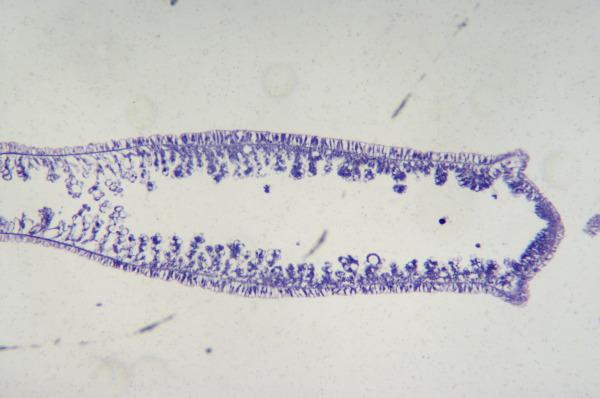
So I emailed the vendor, saying that this sure didn’t look like a Hydra to me, and I suspected it was some kind of Planarian (flatworm). I got email back thanking me for reporting the problem. The customer service rep said her boss, the owner of the company, had looked at the rest of their stock of that slide and pulled it from inventory because the quality was unacceptable. He maintained that it was in fact a Hydra ls, however, but that the sectioning was poor and didn’t show any “polyps”. Okay, whatever. But Hydras are vase-shaped, with a thinner portion on the posterior, where the basal disk is located, then swelling to larger diameter for most of the body, and again narrowing toward the mouth and tentacles on the anterior end.

Of course, the real problem is that the average student is going to assume, reasonably enough, that the slide label is accurate, so that student may look at what he assumes is one type of specimen when in fact it’s quite another. That can get confusing fast.

That’s one of the major reasons–along with typically poor sectioning and staining–that led me to rule out Chinese slides when I was considering assembling my own slide sets. Indian slides are generally much better than Chinese slides, with decent specimen selection and sectioning as well as useful staining. The problem with Indian slides, unless you import them directly in large volume, is that US resellers are generally clueless about what specifically they have available. Also, if a particular slide is out of stock, it’s often literally several months before it’s back in stock.

So that’s why I decided to punt the slide sets to Triarch. They carry about 4,500 different slides, nearly all of which are always in stock. If they do run out, they make another batch quickly. And anyone who buys Triarch slides knows exactly what they’re getting and can be confident that what they’ve ordered is what they received. Triarch slide sets won’t be cheap in any sense of that word, but they also maintain their value. People who pay $90 for a set of Triarch slides for a school year should be able to turn around after that year and resell that slide set for very nearly what they paid for them.

Read the comments: 16 Comments
// ------------------------------------------------------------------------------- // end of file archive.php // -------------------------------------------------------------------------------