Category: science kits

Thursday, 7 June 2012

08:00 – The Roku box lost its mind again yesterday evening. It decided that it couldn’t connect to our WiFi AP. At that point, the only solution is to repeatedly attempt to connect. That may require anything from several attempts to scores of attempts, which means an hour or more of sitting there clicking the button on the remote and watching the same configuration screens over and over again. It’s absolutely hateful. Roku’s firmware is the absolute pits, and their so-called “support” is entirely useless. The product is defective by design. When it works, it works well, but when it doesn’t work it’s an exercise in frustration to get it working again.

And it lies. When it was claiming not to be able to find a wireless AP, I went in and checked the configuration screen on our wireless AP. It indicated that the Roku box was connected via 11.g at 54 Mbps and 100% signal strength. Although it’ll be a pain in the ass, I finally decided to bite the bullet and do a UTP run between my office and the back of the TV in the den. Presumably, even the Roku box will connect if it has a hardwired network connection.


I’m still designing labels for the chemicals and specimens in the forensics kit. There are a lot of them. I still haven’t costed out the kit, but I suspect the full kit may have to sell for $240 or more. Many of the items are needed for only one lab session, and several lab sessions require multiple unique items, so we may end up offering two kits; a full version and a less expensive subset.

Read the comments: 43 Comments

Tuesday, 5 June 2012

09:15 – Fortunately, Barbara has a sense of humor about these things. The library is now so full of boxes from our wholesale suppliers that the floor is barely visible. We’re building inventory for the autumn sales rush, on the theory that we can’t build the kits if we don’t have the components. Actually getting them built is another matter, but we’ll manage somehow.


Read the comments: 14 Comments

Monday, 4 June 2012

08:00 – We made up 120 packets each of various OTC medications for the forensics kits yesterday. Things like acetaminophen, aspirin, diphenhydramine, and so on. They’re used as proxies for illegal drugs in the forensic drug testing lab sessions.

I almost choked when I started designing the labels for these. Here’s an example of the safety warnings for one of the drugs, 25 mg diphenhydramine tablets, AKA Benedryl.

Health: 3 (serious)
Fire: 1 (slight)
Reactivity: 0 (minimal)

WARNING! Extremely hazardous (eye contact). Very hazardous (ingestion, inhalation). Hazardous (skin contact).

Wear gloves and splash goggles.

This is for a Benedryl tablet! Talk about the boy crying wolf. If a Benedryl tablet presents a “serious” health hazard, why would anyone take seriously the same level of hazard specified for another chemical that actually is hazardous, such as concentrated hydrochloric acid? (Yes, both concentrated hydrochloric acid and diphenhydramine tablets are assigned a 3 (serious) for Health.) In reality, these tablets should be listed as non-hazardous, as any reasonable person would expect.


This month the euro chickens are coming home to roost. Even the eurocrats have stopped pretending that the euro can be saved. They are now talking openly about the collapse of the euro and the EMU. Spain is beyond salvage, and will be forced to seek a bailout. The problem is, Spain needs more than half a trillion dollars to carry it through the next 12 to 18 months, and the bailout cupboard is bare. Cyprus has collapsed, Spain is next, and Italy isn’t far behind.


12:58 – Here’s an interesting article from Business Insider: Don’t Mean To Be Alarmist, But The TV Business May Be Starting To Collapse. The author compares the newspaper business–which as little as a decade ago was still fat, dumb, and happy–with the television business, which doesn’t seem to realize that it’s in the same desperate straits now as the newspaper industry was then. At the turn of the century, the newspaper industry had its all-time highest advertising sales revenues, about $63 billion a year. Then newspaper advertising fell off a cliff, declining by two-thirds to about $20 billion last year. Meanwhile TV executives are currently enjoying record ad revenues, and seem not to realize that those revenues are about to fall off the same cliff.

Barbara and I were early adopters and early cable cutters, but now it seems that an increasingly large percentage of cable TV and satellite TV subscribers are following our lead. We haven’t watched even one network TV episode in a decade, other than on Netflix streaming or on DVD. Barbara watches golf on weekends, and sometimes ACC basketball in season. We’ll sometimes watch the local cable news/weather channel for a few minutes. That’s it. Nothing else we watch has commercials, and we watch nothing else live.

And it’s not just us. Nearly everyone we know would immediately give up cable TV if only they could get live sports otherwise. One has to wonder how much longer the NFL, NBA, and MLB will continue to in effect subsidize TV networks by selling them their programming. Each of those leagues is fully capable of going it alone, selling season subscriptions directly to their fan bases, for delivery via broadband. And there’s no question that they could make more money doing it that way. Sports fans would love it. Rather than getting whatever game the network decided to broadcast, they could pick and choose among several or many feeds and follow their favorite teams every week. Smaller sports like golf, tennis, and auto racing could make arrangements with companies like Netflix (Sportsflix?) to use their delivery infrastructure. Everyone except the TV networks would be better off.

Read the comments: 25 Comments

Sunday, 3 June 2012

08:21 – I rethought my idea of making up items in batches of 120 to 180, because that raises the possibility of having an unbalanced inventory. When it comes time to make up more kits, we might end up with far too many of one item and none of another item. We decided that 30 kits was a convenient batch size, so yesterday we labeled containers for 30 more chemistry kits, which is about 1,500 bottles and packets. Once those are filled, we’ll have sufficient materials to give us about 60 chemistry kits and 60 biology kits in inventory, or at least the items we need to assemble them quickly. At that point, we’ll do a batch of 30 forensics kits, and then alternate among the three kits to continue building inventory through the summer.


Read the comments: 21 Comments

Saturday, 2 June 2012

08:25 – The usual Saturday. I’m doing laundry and Barbara is doing yardwork and running errands. We’re also packaging chemicals for the kits.


Read the comments: 1 Comments

Friday, 1 June 2012

07:55 – FedEx showed up yesterday with the first batch of stuff I ordered to build kit inventory in preparation for our busy time starting in August. This round, we’re ramping up a bit. For example, one of the line items on the last order I made to this vendor was for 100 sets of splash goggles. This order had the same line item, but for 500 sets.

We’re also ramping up batch sizes on stuff. For example, in the past we might make up 30 or 60 bottles at a time of a particular chemical, depending on whether that chemical was included in the biology kit, the chemistry kit, or both. We’ll now double or quadruple those batch sizes, depending on the chemical, the container size, and the kits that chemical is used in.

We’re also in the process of transitioning away from dropper bottles to standard screw-cap bottles. We’ve been using the dropper bottles mainly because they’re “expected”. That is, most science kits use 15 mL or 30 mL dropper bottles, so we did the same. But dropper bottles are more expensive, require more steps (and time) to fill, and are more likely to leak in transit. A few of our kit buyers have reported accidents with them, when they squeezed so vigorously that they popped out the dropper tips. Bottles with standard screw caps are also more convenient to use, enough so that many kit buyers simply pop out the dropper tips and discard them. So it makes sense to forget about the dropper tips and just use screw caps. We have a lot of the dropper bottles in stock, so we’ll continue to use them until we run out of them, but then it’ll be screw caps all the way.


Read the comments: 4 Comments

Thursday, 31 May 2012

07:40 – Illustrated Guide to Home Forensic Science Experiments is officially complete and off to O’Reilly’s production folks. I’ve already issued several purchase orders for the forensics kits, and will be putting together and issuing more of them over the next few days.


10:08 – I’ve enabled registration for this site, which I’m hoping will allow registered users to edit their own comments, at least for a short time after they post them. If you’re a regular here, please go ahead and register and let me know if you can edit your own comments.


16:44 – That loud sucking sound you hear is the sound of people withdrawing their money from Spanish banks. The MSM hesitates to call it a bank run, but what else would you call a net withdrawal of about $125 billion for the month ending today? Like all other eurozone banks, all Spanish banks are not just bankrupt but zombiefied. Their net worth is so far into the red that there’s nothing to be done. The Spanish government, bankrupt itself, can’t help them. The EU can’t help them. The IMF can’t help them. The ECB has already put more than $1 trillion in funny money into the EU banking system. As I predicted, that’s actually done more harm than good. It delayed the final collapse, of course, but at what a price. Spain is very close to following Greece down the tubes, and there’s nothing anyone can do now to stop it. Expect severe capital control measures to be implemented, possibly as soon as tomorrow. Not that those will do any good.

Even EU, ECB, and IMF officials are now speaking openly about the collapse of the eurozone, and “collapse” is one of the kinder words they’re using. This is a real train wreck, not just for Greece and Spain, but for the rest of the eurozone. The UK, Sweden and other EU nations that are not members of the eurozone will also suffer heavily, but nowhere near as badly as those in the eurozone. Germany has to be very near the point of abandoning the euro, if only in self-preservation.

Read the comments: 56 Comments

Wednesday, 30 May 2012

07:41 – You’ve probably seen phenolphthalein used as an acid-base indicator. In solutions ranging from acidic to moderately basic, phenolphthalein is colorless; at pH 10 and higher, phenolphthalein is fuchsia. (Okay, “fuchsia” is a girl-color, and I annoy Barbara by pronouncing it as German. Guys would call the color “pink”, or, if they’re into photography and imaging, perhaps “magenta”.)

At any rate, the forensics kit includes a 30 mL bottle of Kastle-Meyer reagent, a presumptive color test for blood. I had planned to buy the stuff premade, figuring it might cost me $30/liter or thereabouts. Instead, I found several suppliers, the least expensive of which was charging $230/liter. Geez. Obviously, taxpayer-funded law enforcement agencies aren’t too concerned about price.

It’s easy enough to make the stuff up, so that’s what I’ll do. All it requires per liter is 20 g of phenolphthalein, 200 g of sodium or potassium hydroxide, and about the same amount of zinc. You start by dissolving the hydroxide in about 900 mL of distilled or deionized water. Phenolphthalein powder is extraordinary insoluble in water, but freely soluble in a strong aqueous base solution. (And a 20% w/v solution of sodium or potassium hydroxide counts as a “strong aqueous base solution” in spades…)

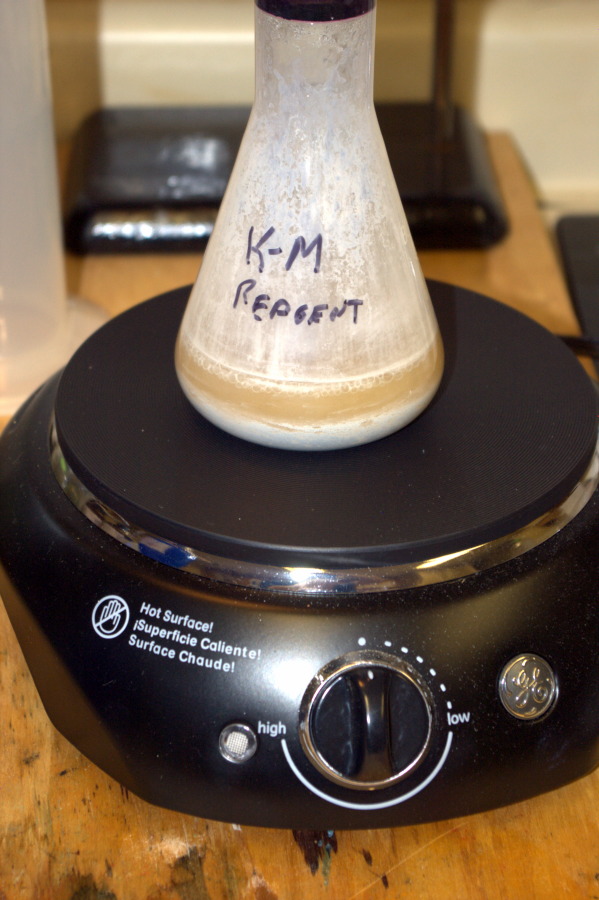
Of course, as the phenolphthalein powder dissolves, the solution turns an incredibly intense fuchsia color. That’s where the zinc comes in. It reduces the phenolphthalein to pale yellow phenolphthalin. The instructions for making up KM reagent always talk about refluxing the solution until the pink color changes to pale yellow. I was hoping to avoid refluxing large volumes of a 20% hydroxide solution–the stuff is fearsome enough at room temperature, let alone boiling–so I decided to make up a small sample batch at room temperature. I made up 100 mL and let the stuff sit at room temperature for two or three weeks, with occasional swirling. Over that time, it turned from pure pink to an orangish pink.

So yesterday, I decided to speed things up a bit by refluxing the solution. The problem with that is that strong hydroxide solutions literally dissolve glass, even at room temperature. At boiling, they simply eat glass. After two or three weeks of contact, the 250 mL Erlenmeyer flask that I’d made up the solution in originally was already etched, so I decided to see what would happen at boiling. The image below shows the grisly details. What look like white chemical deposits on the sides of the flask is actual where the glass has been etched. But the good news is that after only 30 minutes or so of refluxing the solution has assumed its final light yellow color.

This little experiment did lead to a change in plans, however. I was expecting to have to reflux the solution for at least two or three hours. To do that refluxing in volume, I planned to buy a large round-bottom flask (or several) and a Graham condenser with ground-glass joints, and dedicate them to making up KM reagent. If you’ve ever priced glassware with ground-glass joints, you know how costly it is. Even the Chinese stuff ain’t cheap, and I’m not at all sure how many iterations the flask and condenser would survive. So I decided instead to order some large (2 L to 5 L) Erlenmeyer flasks, which aren’t cheap, but they’re a lot cheaper than ground-glass glassware. And I won’t need a reflux condenser at all. For the sample batch, I simply placed a one-hole stopper loosely in the neck of the 250 mL Erlenmeyer, brought the solution to a boil and then turned it down to simmer. There was a small amount of steam exiting the hole in the stopper, but not enough to noticeably reduce the volume of the solution over the whole reflux period.


Read the comments: 12 Comments

Tuesday, 29 May 2012

08:25 – Barbara is off to take her dad to the doctor and then head in to work. Her mom and dad both seem to be doing fine.


Over the next couple of months, we’ll focus on building inventory of the biology, chemistry, and forensic science kits. We currently have about two dozen each of the biology and chemistry kits in stock, with components to build about 30 more of each. By the first of August, I want to have enough components in stock to assemble at least 200 of each, plus 100 forensic science kits. Over that three month period starting 1 August, I want to be prepared to ship a total of at least 500 kits.

Read the comments: 44 Comments

Monday, 28 May 2012

08:02 – It’s Memorial Day here in the U.S., the day set aside to remember those who sacrificed themselves to protect our freedom. Although the official purpose of Memorial Day is to remember those who gave their lives in the service of our country, let’s also remember all of those brave men and women, living and dead, who through the years have put their lives on the line to protect all of us. As we have our cookouts and family get-togethers today, let’s all take a moment to think about our troops in the Middle East and elsewhere, who can’t be with their families. And let’s have a thought, not just today but every day of the year, for them and the sacrifices they are making and have made.


Barbara is heading over to have lunch with her parents today. This afternoon, we’ll build more kits and work more on getting the basement organized. We’re going to a numbered bin system for organization. For the biology, chemistry, and forensics kits, we’ll need something more than 200 numbered bins. Some of those can be pretty small. For example, it doesn’t take a very large bin to store, say, 250 stirring rods or spatulas. Conversely, some will be much larger. For example, 100 splash goggles fill a good-sized box. And there will be many bins with the same number. For example, we get 250 mL beakers in boxes of a dozen. Those happen to be bin number 140, so when I order in 15 boxes of those beakers, we’ll have 15 boxes stacked up together, all labeled 140. Once we get this all set up, it should making picking and assembling kits much faster.

Read the comments: 31 Comments
// ------------------------------------------------------------------------------- // end of file archive.php // -------------------------------------------------------------------------------