Category: politics

Thursday, 21 July 2011

08:24 – Watching the antics of the German and French leaders in the hours before the euro crisis summit, I was reminded of Butch Cassidy and the Sundance Kid, when Butch and Sundance were working as payroll guards:

Butch Cassidy: I think they’re in the trees up ahead.
Sundance Kid: In the bushes on the left.
Butch Cassidy: I’m telling you they’re in the trees up ahead.
Sundance Kid: You take the trees, I’ll take the bushes.
Percy Garris: Will you two beginners cut it out.
Butch Cassidy: Well, we’re just trying to spot an ambush, Mr. Garris.
Percy Garris: Morons. I’ve got morons on my team. Nobody is going to rob us going down the mountain. We have got no money going down the mountain. When we have got the money, on the way back, then you can sweat. .

But, after seven hours of discussion, Merkel and Sarkozny apparently got some sort of agreement hashed out. Once again, one of the scenes from the movie sums it up.

Merkel: Alright. I’ll jump first.
Sarkozy: No.
Merkel: Then you jump first.
Sarkozy: No, I said.
Merkel: What’s the matter with you?
Sarkozy: I can’t swim.
Merkel: Are you crazy? The fall will probably kill you.

The early news from the conference isn’t good. Apparently, the bank tax is off the table, not that it would have done much good anyway. It seems that Eurobonds are the last option left, and I can’t see Germany, Austria, Holland, and Finland agreeing to those. The other option is boosting the EU bailout fund and allowing it to purchase junk bonds from the troubled Eurozone nations, but that’s not doable in the short term.


More lab work today.


13:32 – Oh, my. Things have already started to unravel. The main goal of the crisis summit wasn’t to save Greece. Greece is unsavable, and everyone was perfectly aware of that. The real goal was to stop the spread of “contagion” to Spain and Italy. It’s too late for that. Spain and Italy are already infected, and nothing done at the summit can change that. Spain today auctioned €1.8 billion in 10-year debt, a set-piece low face-value auction intended to demonstrate the beneficial effects of the summit. It instead demonstrated the opposite. The average yield was very close to 6%, a yield that most economists consider to be in the extremely dangerous range. Although estimates differ slightly, most would agree that 6% to 6.5% is disastrous and 7% undoubtedly fatal.

Read the comments: 13 Comments

Wednesday, 20 July 2011

08:53 – In the lead-up to the EU crisis summit tomorrow, it seems that the EU authorities can do nothing but bicker about which unworkable plan each prefers. It seems that the leading candidate is now Euro bonds, which would allow unstable economies like those of Greece, Ireland, Portugal, Italy, and Spain to issue sovereign debt instruments that are backed by the creditworthiness of Germany and other stronger northern European economies. In effect, this “solution” gives Greece Germany’s credit card and allows Greece to run up essentially unlimited debt which Germany is then responsible for paying. That’s kind of like asking me to co-sign a mortgage loan for an unemployed homeless person. Why would I do that? Why would Germany? If this is the best solution the EU authorities can come up with, the Euro is doomed.

Ultimately, the problem comes down to one of authority versus responsibility. The Europeans have an economic union, but not a fiscal union or a political union. Eurozone member nations are actually not nations in the traditional sense. A nation controls its own money. Eurozone members have given up that control, which amounts to giving up sovereignty. A sovereign nation can never be forced into default on debt instruments denominated in its own currency. The US, for example, is never in danger of defaulting on dollar-denominated bonds because, if push comes to shove, the US can simply print more dollars. The same is not true for Eurozone members, who have accepted responsibility while giving up authority.

The result of all this is that we now have a cat fight, with poor, unproductive, and deeply-indebted EU nations able by their actions to destroy the common currency, and wealthier and more productive nations faced with few alternatives but to pay the huge bills that have been incurred by those profligate nations. What’s worse is that this won’t be a one-time bailout. Those poor nations will continue returning to the well, expecting the richer nations to go on subsidizing them indefinitely. Obviously, that’s unsustainable.


UPS showed up yesterday with boxes from one of my wholesalers, which contain about 20% of the components I need to assemble another 60 chemistry kits. I already had about 10% of the components in hand, and nearly all of the remainder should arrive by the end of this month, with one exception. One small item is backordered, and I can’t find another source for it. It’s due to ship by 15 August, so I’m limited to on-hand inventory for about the next four weeks. Fortunately, this is the slowest time of year for kit orders, so I shouldn’t have to backorder many kits. I hope.


09:45 – I finally decided I had to do something about my inbox. I use it as a kind of pseudo-to-do list, marking action items as “unread” and think-about items as read. As of this morning, I had more than 600 messages in my inbox, some of them from last year. All real messages. So I just spent the last 45 minutes getting rid of the ones that were OBE (most of them), doing something about the ones that still required doing something about, and leaving the ones that require doing something about, but which will require more time than I have to devote to them at the moment. I’m now down to eight messages in my inbox.

Usually, I try hard to keep the number of messages in my inbox small enough that they don’t fill the message-list pane. When a scroll-bar appears for that pane, I know I need to do some pruning. This time, I let it get completely out of control. I’ll try to keep that from happening again.

Read the comments: 2 Comments

Tuesday, 19 July 2011

08:28 – Spain auctioned a couple billion worth of short-term bonds today. They kept the face value low and the maturities short, hoping to cherry-pick low interest rates and thereby demonstrate that the market still has confidence in Spanish debt, which it doesn’t. Even with the low face value and short maturities, they ended up paying nearly a full percentage point more than they did on their last auction of similar bonds a month or so ago. That bodes very ill for future bond auctions for Spain, and particularly for Italy, which has a huge amount of debt that needs to be refinanced in the coming months. The next Spanish bond auction is set for Thursday, the same day the EU holds its crisis meeting. That auction is for long-term bonds, which are likely to sell at disastrously high interest rates, if at all.


Lab day today.


12:12 – Merkel says that nothing that happens at the summit meeting Thursday will solve the Greece crisis, and she’s right. But I think what she’s really doing is signaling that, as far as Germany is concerned, enough is enough. All of the “solutions” proposed thus far involve Germany paying the lion’s share of the costs, and Germans are tired of being sucked dry to prop up a poor southern fringe EU country that’s going to fail no matter what happens. Germans rightly consider any additional funding provided to Greece to be good money after bad.

At this point, I really don’t see any alternative to the Eurozone collapsing into fragments. Even if the Greece problem were solvable, which it isn’t, Greece is the least of the Eurozone’s problems. The gorilla in the room is Spanish and particularly Italian debt, hundreds of billions of which will need to be refinanced in the coming year. There is simply no way that Germany can fund that effort, and any money it throws down the Greek rat hole now is simply damaging its future prospects. The real question is whether Germany will opt in the relatively near future to abandon the Euro and return to the Deutschmark, or whether Germany will join with France, the Netherlands, and other relatively stronger northern economies in a new Eurozone. My guess is the former. Germany was never really happy about having a common currency, and events have proved them right.

Read the comments: 12 Comments

Monday, 18 July 2011

08:34 – As expected, the Euro is getting hammered this morning. Yields on Spanish and Italian debt have jumped by about 0.2 percentage points already this morning, with worse to come. The EU authorities made a major blunder with their feel-good “stress test” results. They released the actual data, which means that investors could and did plug in their own assumptions and run them against that data. And the results aren’t pretty.

The two major phony assumptions made for the official bank test results were that no sovereign default would occur and that a 5% core capital requirement was sufficient. In reality, of course, there will be a default. In effect, Greece has defaulted already, with Portugal and Ireland teetering on the edge and Spain and Italy not far behind. Even without a default, using a more realistic 7% capital requirement puts the majority of European banks in bankruptcy and a so-called conservative 10% capital requirement puts all of them in deep, deep trouble. With a default, they’re toast.

Meanwhile, the higher yields on Spanish and Italian debt threaten their immediate solvency. For the Italians, for example, a 1% increase in yield costs them about €8.5 billion per year, so it doesn’t take much to wipe out the effects of the recent Italian so-called austerity measures. The EU authorities continue kicking the can down the road, most recently by delaying the crisis summit from last week until Thursday of this week. I was about to say that they’re running out of time, but the truth is that they’ve already run out of time. This will play out now no matter what they do Thursday.

This is devolving into a fight between the richer northern countries, which perhaps not coincidentally are all secular, and the poorer southern countries, which are all Catholic. I think a breakup of the Eurozone is a foregone conclusion, with the richer, productive northern countries refusing to continue to subsidize the poorer, unproductive southern countries. German citizens were never happy about the Euro to begin with, and there is now strong sentiment for abandoning the Euro and returning to the Deutschmark.

Meanwhile, Greece has begun uttering threats, including floating the idea of withdrawing from the Euro. Some threat. Greece reminds me of that scene in Blazing Saddles, where Bart takes himself hostage and threatens to shoot himself in the head unless everyone backs off. It worked for Bart, but it’s not going to work for Greece.


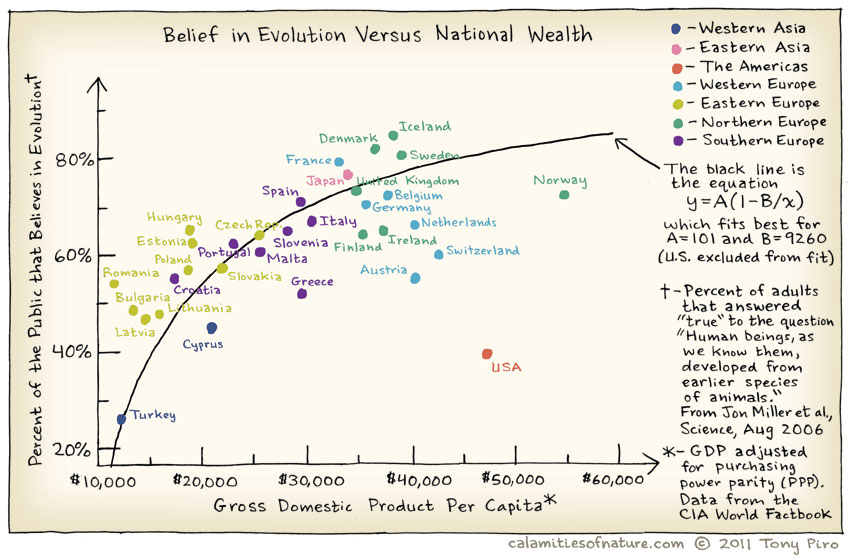
11:10 – Here’s a fascinating graph from Calamities of Nature of GDP versus belief in evolution that makes very clear just how much an outlier the US is.

13:24 – Geez. Talk about inflation. I was ordering some chemicals from one of my suppliers, but the website was misbehaving, timing out and dumping the contents of my cart. So I emailed the purchase order to them and called to follow up. As usual, we got into a discussion about stuff unrelated to the order.

He verified that everything on my list was in stock and ready to ship, but mentioned that he was having terrible problems restocking some chemicals. One of them is silver nitrate. All of his suppliers have plenty of it, but none are willing to sell any because the price of silver just keeps going up and up. And the potassium iodide situation is nearly as bad. Back when the Japanese reactor problem occurred, you couldn’t get potassium iodide for love or money. Every bit of it was being made into KI tablets. Everyone expected sanity to return once the Japanese scare was over, but it hasn’t. Since that event, the price of potassium iodide has literally quadrupled to quintupled, and there’s no relief in sight.

None of that really surprised me, but some of the chemicals in short supply and/or experiencing major price jumps are so commonplace and cheap that I had trouble believing there is actually a shortage. For example, ammonium acetate. Ammonium acetate? Geez. You make the stuff by neutralizing glacial acetic acid with concentrated ammonia, both of which are cheap and available literally by the tanker load, and evaporate the water. There’s no possible way there should be a shortage of ammonium acetate, and yet there is.

14:15 – Oh, my. Things are suddenly even worse, with evidence that the “contagion” is now extending to France and even Germany. The price of CDSs for both nations jumped today, with France jumping from 114 to 123 basis points, and Germany from 60 to 64.

A CDS (credit default swap) is basically an insurance policy against a debtor defaulting, at which point the debt holder is paid the face value and in return signs over the (bad) debt to the CDS issuer. The premium for a CDS is specified in basis points, or one one-hundredth of 1%. Right now, Greece CDSs are at 2500+ basis points, or more than 25%. In other words, insuring €1 billion of Greek debt involves paying premium of €250 million. Does that mean that Greek debt is currently worth 75% of face value? Not at all. The CDS premium reflects the fact that CDS issuers are still expecting some sort of bailout for Greece. Absent that, the current CDS premium on Greek debt would probably be at 9000+ basis points and possibly 9900+ basis points. Essentially no one outside the EU authorities really expects Greece to survive this mess. They’re treating Greece as though it had already defaulted, and rightly so.

The scary thing right now is that CDS prices on French and German debt are increasing substantially. They’re still relatively small, at only a few percent of CDS premiums on Greek debt, but they’re increasing rapidly in percentage terms, and that indicates that investors are at least somewhat concerned about the likelihood of a French or even German default. As someone commented, if investors start looking with concern at France, it’s game over for the Euro.

Read the comments: 24 Comments
// ------------------------------------------------------------------------------- // end of file archive.php // -------------------------------------------------------------------------------