Category: politics

Sunday, 6 November 2011

08:16 – The G20 conference ended in failure as far as the EU was concerned, with the other nations telling the EU that they wished them well but they were going to have to come up with the money themselves to bail out the euro. The problem with that is that the EU simply doesn’t have the $3 trillion to $5 trillion it needs, just for a start, to bail out Italy, Spain, and France, not to mention the other smaller nations that are under threat. Meanwhile, while the G20 was sitting around the table discussing what emergency measures to take to save Italy from collapse, Berlusconi fell asleep. Twice.

The other G20 nations pushed for the European Central Bank to address the crisis by monetizing the debt by printing euros. Lots of euros. Euros by the ton, literally. At this point, the only solution, bad as it is, that anyone can see is for the ECB to inflate the euro dramatically. But the ECB is having none of it. And they’re right, if not in the short term, certainly in the medium- and long term. At this point, the eurozone is going to take a huge economic hit no matter what happens, as will, to a lesser extent, non-eurozone EU countries, and, to a lesser extent still, the rest of the world. Right now, all the arguing is about who is going to take how much of that hit, and how.

The takeaway lesson from all of this is that government and the economy is too important to be left to the politicians, nearly all of whom are, at best, mediocrities. That’s why we need strong Constitutional protections that will handcuff the politicians, limiting the damage they can do. A rigid balanced-budget amendment that makes no provision for exceptions, including in time of war, would be a good start.


Read the comments: 14 Comments

Thursday, 3 November 2011

08:28 – I drove Barbara to an appointment with her doctor yesterday. Barbara drove us home, approved to drive again and return to work. She just left for work, making joyful noises.


The Greek government will likely collapse this week, probably after a vote of (no) confidence tomorrow. Papandreou is down to 149 of 300 seats, and it’s by no means certain that all of those 149 will vote to support him. Papandreou’s finance minister and heir presumptive, Evangelos Venizelos, is now in open rebellion against Papandreou, but again it’s by no means certain that Venizelos would be able to form a new government. What’s really worrisome is that Papandreou has just sacked and replaced the top officer corps of the Greek military, presumably because he fears a military coup is at least possible, albeit not probable at this point. Meanwhile, EU officials are now talking openly about the departure of Greece and the breakup of the eurozone and probably the EU itself, and Italian bond yields reached 6.4%.


12:48 – And now I see that Papandreou has withdrawn his call for a referendum. Merkozy made it clear that the gloves were coming off, not least by announcing that Greece would not receive the sixth and final aid tranche, due to be paid this month, unless Greece did exactly what it had been ordered to do. Without that €8 billion payment, Greece will not be able to pay government employee salaries and pensions, which means Greece would likely be in full revolution soon after the first payment is missed. Merkozy also made it abundantly clear to Papandreou that the referendum announcement was the final straw, and that they were fully prepared to expel Greece from the eurozone. Because it is technically and legally impossible to expel a nation from the eurozone without also expelling it from the EU–actually, there’s no legal mechanism to expel a nation, period, but the one implies the other and Merkozy has certainly shown they have no respect for EU treaties or laws–Greece would find itself not just being forced to convert overnight to the new drachma, but also cut off from all of the benefits of EU membership, such as free trade within the EU.

Not surprisingly, the Greeks are back-pedaling fast, but it’s probably too late for that. Even the mention of a Greek referendum was the small shove that was needed to set the eurozone in particular and the EU in general toppling. Even the fact that the new head of the ECB announced a 25-point cut in interest rates to 1.25% and promised to keep subsidizing Italian and Spanish bonds isn’t going to help stop the collapse. At this point there’s only one solution remaining: the ECB has to start printing euros by the boatload to allow that massive pile of sovereign debt to be paid off in inflated euros. Of course, if there’s one thing Germany won’t stand for, it’s inflating the euro. If that begins to happen, you can be sure that Germany will revert to its own currency, quickly followed by the rest of the FANG nations, leaving the southern tier, including France and Belgium, twisting in the wind. So, one way or the other, it’s a default for sure.

Read the comments: 11 Comments

Wednesday, 2 November 2011

08:48 – Merkozy have scheduled another failed summit for today, calling Papandreou on the carpet to explain how he dared give the Greek people the right to vote on what Merkozy had decided Greece must do. Obviously, the EU elitists can’t afford to allow little things like freedom, democracy, and national sovereignty obstruct their grand plans for EU über alles. In all fairness to Merkozy, though, they’re not just picking on the Greeks. They don’t want German and French citizens to have any say, either. Nor any other EU citizens. If only everyone–especially those troublesome ratings agencies and the market itself–would stop asking questions and just do what Merkozy order them to do, the trains would run on time.

Meanwhile, making it obvious that Greece is just a distraction from the real problem, benchmark Italian 10-year bond yields have now reached a disastrous 6.2% and continue to climb. It’s long past time to stop rearranging deck chairs and start heading for the lifeboats, i.e., converting as quickly as possible back to local currencies.


12:11 – It starts again. One would think big publishers might have noticed the catastrophic results when music companies and movie studios decided to start suing listeners and viewers, but apparently they’re too stupid to learn from others’ mistakes. So Wiley has decided to track down and sue people who share Wiley books on torrent sites.

I suspect that Wiley isn’t even aware that it’s not illegal, in the US at least, for people to download a torrent of a copyrighted work. To the extent that the music and movie industries have had any success against torrents, it’s been to persecute those upload the material, not those who download it. In fact, those industries strove mightily to establish the very questionable legal concept of “making available”, just so they wouldn’t actually have to prove that their targets had actually uploaded any data. For now, merely “making available” that data to others is the crime. Someone who takes advantage of that availability commits no crime. Of course, the music and movie industry would like to see that change to include downloaders, but that’s not likely to happen any time soon.

Read the comments: 22 Comments

Tuesday, 1 November 2011

08:58 – Greek Prime Minister George Papandreou is being universally reviled for doing the right thing: calling for a referendum to allow the Greek people to decide their future. Merkozy are spitting nails right now, because Papandreou has just thrown a gigantic monkey wrench into the save-the-euro plan they came up with at their failed summit last week.

The real problem, of course, is that the EU wrote off Greece long ago as unsalvageable. Their plan has nothing whatsoever to do with helping Greece; it’s all about helping Greece’s creditors, many of whom are German and French banks. Whether or not the plan goes forward, Greece is toast. In either case, Greece faces literally decades of economic disaster and human suffering.

Calling for a referendum really is a stroke of genius. At this point, Papandreou has basically called the EU’s bluff and, at the same time, shifted responsibility for the decision from his own government to the Greek people. It almost doesn’t matter if the referendum is actually held or, if it is, what the outcome is. It is, if not win-win for Papandreou, at least a less-lose either way. The ideal outcome from Papandreou’s point of view would be for the EU to write off Greece’s debts without requiring the austerity measures that they have so far demanded. I have no doubt that that’s one of the options that Merkozy will be discussing during their emergency phone conference today. Alas for Greece, I don’t think that’s what’s going to happen.

I think what’s more likely to happen is Merkozy deciding to drop Greece like a hot potato, even if that does make a chaotic Greek default almost certain. Make no mistake. Right now, Angie and Nick are seriously pissed. From their point of view, they held out an olive branch to Papandreou and he just shit on them. There are so many players involved, not least the IMF, that it’s difficult to predict short-term outcomes, but I think it’s even possible that the EU/IMF/ECB will decide to withdraw the sixth aid tranche that was to be paid to Greece in the next couple weeks.

That would, of course, immediately topple Greece into chaotic default, but ultimately it won’t matter. Merkozy certainly understand by now that that outcome is inevitable, so from their point of view the only real question is whether it’s worth buying a few more weeks before they have to deal with the fallout. Ultimately, the aid payments are just paper shuffling anyway. Each of the bailout payments is simply an accounting transfer from the bailout fund to Greek creditors. Why not take Greece out of the loop entirely and simply make those transfers directly to the creditors? Or, more specifically, why not simply have the German government make bailout payments to the German banks who have Greek payments due, the French government make payments to French banks, and so on? The EU governments, the IMF, and the ECB also hold Greek debt, but you can be sure they’re first in line to be paid, and Greece cannot afford to default on those debts if it ever wants to be able to borrow again before the 22nd century. Of course, that leaves non-EU creditors without anyone to pay them. Too bad. So sad.


09:43 – Rule, Britannia! Believe it or not, the Home Fleet is now down to zero vessels. The once-proud Royal Navy, which within living memory deployed huge battleships, battle cruisers, and aircraft carriers by the dozen, is unable to come up with even a tiny destroyer or frigate to protect home waters.

Read the comments: 24 Comments

Monday, 31 October 2011

08:44 – Edward P. Lazear in the WSJ points out something that should be obvious to anyone. The EU problem is too much government. Unfortunately, the only “solutions” they’re considering involve more of what’s caused the problem in the first place. It’s apparently impossible for politicians even to consider that government is the problem, not the solution. And the US has the same problem, albeit not quite as advanced.

Instead, EU politicians blame the market, the ratings agencies, and indeed anything else they can think of other than themselves. They’re now apparently seriously considering implementing a horrible idea that’s been simmering on the back burner for a couple of years now. A so-called “Tobin Tax” on financial transactions. Basically, the idea is that by making it more expensive for traders to trade they’ll reduce volatility in the markets.

Their problem is that, as Sweden found out in spades a few years ago, a Tobin Tax must be implemented globally. When Sweden implemented a Tobin Tax, the markets simply abandoned Sweden and moved their trading elsewhere. The vast majority of market activity in the EU already occurs in London, so implementing a Tobin Tax in the eurozone would simply cause essentially all of the little remaining market activity in the EU to relocate to London and New York, where it would not be taxed. The EU’s solution to this is to attempt to force the Tobin Tax on the UK (which has a veto over such things) and to lobby the US to implement such a tax. It’s not going to work, any more than any of the EU’s other “solutions” have worked. We’re really well into the endgame now.


10:51 – Hmmm. I just finished writing up a lab session on Mendelian inheritance, and realized that I might have a serious problem. Back when we were in school, everyone did the PTC tasting thing, but it was typically done with just the students in a classroom. This lab session is a bit different…

“Testing unrelated individuals provides some useful data, but ideally you want to test as many related individuals as possible so that you can follow inheritance of the PTC tasting and non-tasting alleles through generations of families. Testing both parents and their children is good; testing parents, children, and all four grandparents is better still. Best of all is testing the full extended family, with aunts and uncles and cousins.”

Most of my readers will immediately spot a very serious potential problem there, so I added the following warning:

Any human genetic testing, including this lab session, potentially has serious ethical implications. Many families have at least one “skeleton in the closet” that they’d prefer to keep hidden from the world at large. You are obligated—morally, ethically, and possibly legally—to maintain the absolute privacy of your test subjects by refusing to disclose the data you obtain to anyone else, including the test subjects themselves.

For example, in one of your family groups of test subjects you might find that both parents are non-tasters, as are all of their children except the eldest. You might conclude that that child was adopted or had a different father. Disclosing that conclusion TO ANYONE is a serious ethical violation, and may have direct and indirect consequences you cannot imagine. If you discover such an anomaly, KEEP IT TO YOURSELF.

Also consider this: you are not a geneticist, so you may be wrong.


12:02 – Jerry Coyne comments on Science publishing a new phylogeny of the mammals.


Read the comments: 13 Comments

Friday, 28 October 2011

08:48 – One thing that’s always struck me as strange about Netflix practices is that they don’t allow non-members to browse or search their catalog. One would think they’d want non-members to be able to see what they’re missing.

I just downgraded our plan from streaming + two discs to streaming-only, which took effect Wednesday. With the exception of the final disc of series four of Sons of Anarchy, there was nothing left in our disc queue that we cared that much about seeing, so I planned to go streaming-only for a few months to give Netflix a chance to add more discs that we wanted to watch and then bump up our membership to include discs. But, as of yesterday, I can no longer see anything that has to do with discs. Our disc queue is now invisible, although I understand that Netflix keeps it archived for two years. Not that that matters, since I did a screen capture of it before I changed to streaming-only.

But I can no longer search for discs, nor do search results even include series or seasons that are available only on disc. For example, series one and two of Sons of Anarchy are available on disc or streaming, but series three is disc-only. When I search for Sons of Anarchy now, all I see are the two seasons that are available streaming. Not even an indication that series three is available on-disc.

Given that Netflix is trying very hard to force people toward streaming, I wonder if the converse is true. If I had a disc-only plan, would they let me see what’s available streaming even though I couldn’t watch it? It seems to make sense for them to do that.

Actually, Netflix has made things easier for me. Rather than keeping an eye on new disc-only material, I’ll just wait six months or so and then upgrade our plan to include discs. There certainly ought to be at least a month’s worth of new discs we want to watch by then. Not that we’ll have to wait six months to see the last two episodes of Sons of Anarchy S3. Our friends Paul and Mary subscribe to both discs and streaming, and they tend to let discs sit around for extended periods. I asked Mary the other day if she’d mind getting SoA S3D4 for me, and she readily agreed.


Work on the biology book continues. Right now, I’m working on a lab session on culturing drug-resistant bacteria. Once I finish that session, I think I’ll jump over to a different group for a change of pace, maybe the genetics group or the life processes group. Or maybe even one of the survey groups. I’m also down perilously low in chemistry kit inventory, so soon I’ll have to set aside a day or so to build more chemistry kits.


14:55 – Well, that didn’t take long. In the first real test of the “solutions” reached at the EU crisis conclave Thursday morning, Italy has failed miserably on today’s bond sale. The yield was catastrophic, 6.06%, and Italy was unable to sell all of the bonds it offered. To knowledgeable observers, that’s sufficient evidence to declare the latest crisis summit a complete and utter failure. Not only did the non-actions taken at the summit not reverse the collapse of EU finances, they appear not to have even slowed things down. Contagion continues, unabated.

Of course, none of this crisis kabuki really had anything to do with Greece and not much more to do with the euro or the EU. What it’s really about is an attempt to shore things up until Merkozy can get past the next elections–not that either of them has much chance of being re-elected–and, even more importantly, the continuing push by the EU elite for “more Europe”. They’re actually loving this financial/debt/liquidity crisis, because it supports their long-term anti-democratic plans to consolidate Europe as a single political entity, ruled by them. Fortunately, I believe the FANG nations will refuse to go along with their cunning plan, leaving eurocrats holding the empty bag of the southern-tier nations only. Let them see what they can do with that motley collection.

Read the comments: 13 Comments

Thursday, 27 October 2011

08:45 – How could I have been so wrong? The EU authorities announced this morning that they’d hammered out a comprehensive plan overnight to address the euro crisis. And they’re right. They pretended to deal with every issue facing them (except the important ones), and so far the markets are pretending to believe them. I predict that’ll last 24 to 48 hours before reality sets in.

Private lenders agreed to accept a “voluntary” 50% writedown on Greek bonds. In reality, they accepted an 85% writedown, because what they ended up with was 15% in cash and the rest in 30-year Greek paper, which the market will quickly value at zero, or close to it. And I have my doubts about that 15% cash ever actually being paid. But at least Greek debt has gone from unsustainable to, well, unsustainable.

They’ve also announced that they’re pretending to increase the bailout fund to €1 trillion, although they’re not actually going to commit any more of their own money to it. They plan to use a combination of leveraging (AKA smoke-and-mirrors) and hoping that non-EU countries will be foolish enough to put in pots of money to back worthless EU sovereign bonds. Meanwhile, they’ve papered over the ECB issue simply by not mentioning the ECB at all.

So, the net result of this pathetic effort is that they’ve bought themselves a bit more time. I’d guess they’re hoping for weeks, but I think they’ll be lucky if it’s more than a few days. Keep a close eye on Italian bond yields over the coming few weeks for the real story.


Regular readers probably won’t believe me, but last night I was pumping iron–lifting free weights. Barbara called Mary Chervenak yesterday to ask if she could borrow some weights for a week or two, until she could start going to the gym again. Mary stopped over after dinner and dropped off a pair of 15-pound (6.8 kilo) weights. I actually picked one of them up and carried it into the house. Dense little sucker. Barbara carried the other one.

Read the comments: 25 Comments

Wednesday, 26 October 2011

08:49 – Well, as expected, the crisis summit today has turned into a complete fustercluck. Not only is there zero chance of comprehensive actions to address the euro crisis, the participants can’t even agree about what to argue about. And, oh by the way, the Italian government is teetering on the brink of collapse, mainly because of German demands that Italy increase retirement age to 67, as Germany has done. Collapse of Italy’s fragile coalition was narrowly averted yesterday, but it looks like Berlusconi is on his way out, and sooner rather than later. If that happens, it could be months before Italy again has a functioning government.

The collapse of Italy’s government would eliminate even the slightest mathematical chance of saving the euro and the EU. Even with the ECB buying Italian bonds, yields on those bonds are now above 6%, the catastrophic level that convinced the ECB to intervene in the first place. And Italy has to rollover €250 billion worth of bonds over the coming year, just to stay even. Even with a functioning government, it’s extremely unlikely that Italy could sell €250 billion of bonds over the next year no matter how high the yields. If the government collapses, there’s no question that Italian bond sales will also collapse, leaving Italy with no way to pay off maturing bonds. In other words, Italy will default, joining Greece, Ireland, and Portugal. The EFSF bailout fund is insufficient even to cover expected losses on Greece, let alone Ireland and Portugal. If Italy joins the group of bankrupt nations, there is zero hope that it can be bailed out. And it’s looking likely that Italy will join that group in the next few months, if not the next few weeks.


12:31 – Barbara sent me a link to this forensics blog, which looks very interesting. The author, Tom Adair, is a retired forensics guy with 15 years of experience. Unlike most of the forensics sites I follow, which are intended for forensic scientists and technicians, this blog is targeted at fiction authors and readers. I’ve only looked at half a dozen random articles, but it appears that this guy knows what he’s talking about. If you have any interest at all in real crime-scene investigation and criminal forensics, check out this blog.

Read the comments: 13 Comments

Tuesday, 25 October 2011

09:13 – Geez. Anyone who’s even slightly aware of what’s going on believes that the crisis super-summit tomorrow is the absolute last chance the EU has to prevent the collapse of the euro and the disintegration of the EU. And yet the actions of the leaders of the top four EU countries are reminiscent of the Animal House food fight. We have Merkozy lobbing vicious verbal grenades at each other, both of them publicly making fun of Berlusconi (who richly deserves it, actually), and Sarkozy telling Cameron that Cameron “has missed an opportunity to shut up” and that he’s “sick” of Cameron “interfering” in the discussions. It’s fortunate that European countries no longer have much in the way of military forces, or Germany would probably have invaded France by now. And France would have surrendered. And yet, by tomorrow, these “leaders” are supposed to agree to terms that none of them are willing to agree to and by so doing save the euro and the EU. Not bloody likely.

Not that there’s actually anything that can be done to save the euro or the EU anyway. The euro itself has a fatal design flaw, and no amount of gerry-rigging can fix that permanently. The problem now is that the EU is running out of temporary patches, each of which was extremely expensive and ultimately futile. All of the argument now isn’t about how to save Greece and the euro and the EU; even the politicians by now realize that is impossible. What they’re arguing about now is who will pay the costs of the collapse. Everyone except the FANG nations wants the FANG nations to take the hit, cutting them down to size. The FANG nations aren’t willing to do so. The only thing they’re seriously concerned about is how to minimize the damage to their own economies from the collapse. They’ve already written off not just Greece, but Portugal, Ireland, Italy, Spain, Belgium, and France.


Read the comments: 15 Comments

Monday, 24 October 2011

08:41 – Costco run and dinner yesterday with Mary and Paul. Barbara did very well.


If you don’t like to be frightened, turn away now.

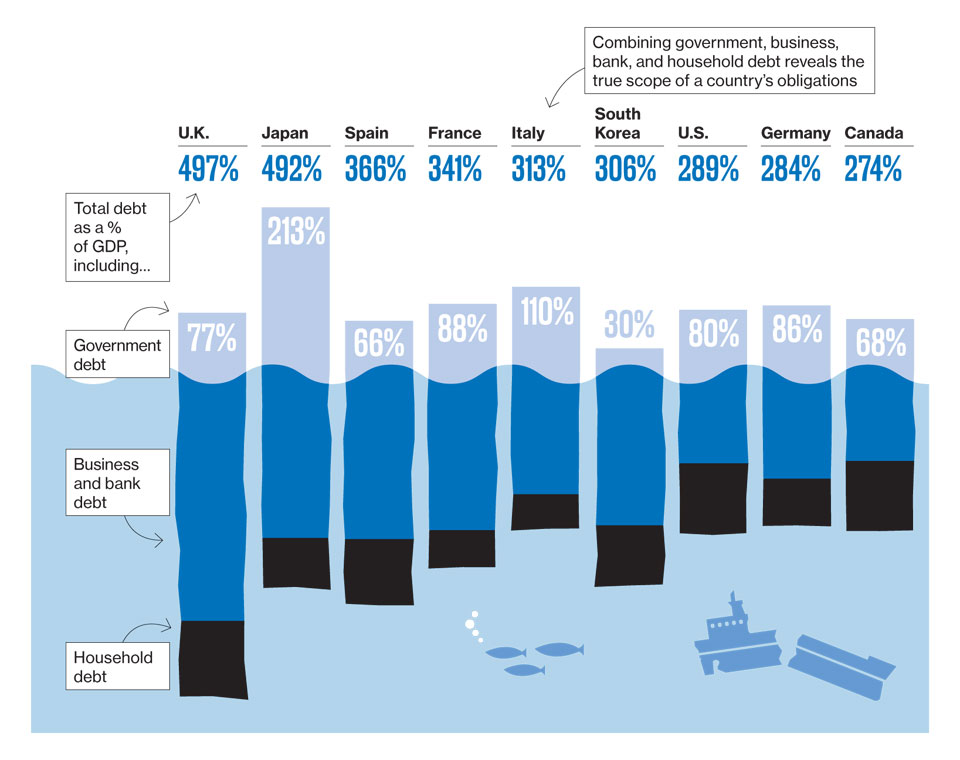
This graphic, from this article, makes clear that sovereign debt, scary as it is, is only a part, often a small part, of the total indebtedness of the world’s major economies.

Roy Harvey sent me a link to this article by Ambrose Evans-Pritchard, whose work I’ve been reading for years. Although Evans-Pritchard buys into Keynesian arguments a bit too much for my taste, in general he’s one of the few MSM writers who actually gets it. He’s a journalist of the old school, and there aren’t many of them left.

In this article, Evans-Pritchard makes the same argument that I’ve been making for some time now, that the US, although hurting, is set to come roaring back more dominant economically than ever. As he concludes, “The 21st Century may be American after all, just like the last.” Indeed.


09:24 – Oh, yeah. I should have mentioned that these numbers are only for formal contractual indebtedness. What they don’t include is unfunded pension and health-care liabilities, which are often much larger than formal indebtedness. Greece, for example, is usually reported to have sovereign indebtedness totaling 160% of GDP. That’s true as far as it goes, but once one adds in personal and business debt and unfunded pension/health-care liabilities, it’s more like 1600% of GDP. The major economies aren’t quite that bad, but unfunded liabilities at the federal and state levels as well as corporate unfunded liabilities still make formal indebtedness pale.

Read the comments: 16 Comments
// ------------------------------------------------------------------------------- // end of file archive.php // -------------------------------------------------------------------------------