Monday, 20 September 2004
[Last Week]
[Monday] [Tuesday] [Wednesday] [Thursday]
[Friday] [Saturday] [Sunday]
[Next Week]
[Daynotes Journal Forums] [HardwareGuys.com
Forums] [TechnoMayhem.com Forums]
{Five Years
Ago Today]
08:00 -
It's a bit difficult to concentrate with all this hammering. Half a
dozen guys are up there now ripping off our old roof. Mr. Tesh tells me
that the shingles will be here by 8:30 and they should be completely
finished by about 13:00. The dogs are taking it surprisingly well. They
barked when the trucks showed up, of course, and again when they heard
people walking around on the roof, but now they're just behaving as
though nothing unusual is going on.
Over the weekend, one of our neighbors suggested that we have them
install a plastic sheeting product that I forget the name of that's
designed to prevent damage from ice damming. When the roofers showed up
this morning, I asked him about that. He said they'd install it if we
wanted it, but it'd cost $400 or so additional.
I asked him if it was worth it. He said, "Nope. We don't install it
on our own roofs." He said it may be worth having up north, but down
here it's a waste of money. Actually, it may be a waste of money
anyway. He said they'd met some roofers from Wisconsin and of course
got to talking about the differences between installing roofs in
Wisconsin versus North Carolina. The Wisconsin guys said they installed
the plastic barrier sheet routinely, but that it doesn't work very
well. Without the sheeting, water forces its way between the shingles
and sheathing and rots the sheathing from the top down. With the
sheathing, water forces itself between the fascia board and the
sheathing, and rots the sheathing from underneath. So we told him not
to bother installing it.

More work today on the articles I'm writing for O'Reilly, tentatively titled Building the Perfect Bleeding-Edge PC.
This one will be a screamer. A Socket 775 Pentium 4 560 (3.6 GHz), DDR2
memory, a pair of NCQ S-ATA Seagate hard drives, S-ATA 12X Plextor DVD
burner, nVIDIA GeForce 6800 GT, etc. etc. This will eventually become
my primary office system.
10:18 - Saturday,
Barbara helped her sister and brother-in-law move a bunch of stuff they
had in storage. They were also having some problems with their PC, so
Barbara hauled it back here for me to work on.
Their Roadrunner service was down when I installed Xandros for them the
preceding weekend, so I wasn't able to get their mail functioning. I
set it up "blind" and when they tried to use it they were getting error
messages about "unable to write to mailbox". A permissions problem,
obviously. When I got it over here, the problem was obvious
immediately. The mailbox directory and files were owned by root. When
I'd copied over their existing mail from the CD I'd burned from their
Windows hard drive, I'd done so as root and forgotten to change owner.
(In my defense, Mozilla Mail opened fine; the problem didn't occur
until mail was actually POPped and Mozilla attempted to write the new
mail to the mailbox.)
So I got that fixed, installed the OS updates I'd been unable to get to
with the cable modem down, and so on. Yesterday afternoon Barbara and I
hauled their system back to their house and set it up. Frances
mentioned that they weren't able to print, either, so I took a look at
that problem. They have a Brother MFC-4800 combo laser printer and fax
machine. When I set up the printer, Xandros listed many Brother models,
including several MFC-**** models, but not the MFC-4800. I picked the
nearest model, which I think was the MFC-6550. As it turned out, that
was the wrong guess.
So I went over to the Brother web page, where I found lots of
information about using their printers under Linux. They had a Linux
lpr driver for the MFC-4800, so I installed lpr and then the MFC-4800
driver. No joy. I then did what I should have done first, a Google search for the terms MFC-4800 and Xandros.
There were three hits, the first of which was exactly what I needed.
Someone had an MFC-4800 printer and told me exactly what I needed to do
to get it working under Xandros. The solution was simple enough. Tell
Xandros the printer was an MFC-8300. Sure enough, that worked
perfectly. The really odd thing was the origin of that helpful page. It was written by my friend Brian Bilbrey. I didn't know until I saw that page that Brian owned a Brother MFC-4800.
[Top]
Tuesday, 21 September 2004
[Last Week]
[Monday] [Tuesday] [Wednesday]
[Thursday] [Friday] [Saturday]
[Sunday] [Next Week]
[Daynotes Journal Forums] [HardwareGuys.com
Forums] [TechnoMayhem.com Forums]
{Five Years
Ago Today]
10:40 -
We have a new roof. They started about 0700 and finished up by 1430.
There were half a dozen guys on the crew, and they worked steadily
except for a short lunch break. The roof looks good. I'm glad we
decided to have them install the GAF Timberline architectural shingles.
The insurance wouldn't pay for the upgraded shingles, which cost about
$600 more than standard shingles, but the better shingles are a lot
heavier and stiffer. Having a new roof means one less thing to worry
about. The joys of home ownership.
PJ over at Groklaw is thinking about getting a new computer.
She's been using a Dell system, and looked to Dell first for her new
system. But then she learned that Dell is Linux-hostile, and so decided
to take her business elsewhere. I suggested that she buy a system from
a local white-box builder or build her own. The latter appeals to her,
probably for the same reason that Linux appeals to her. It's nice to be
in control of one's own destiny.
I see that Dan Rather has apologized, as though that's sufficient. If
CBS News expects to regain any credibility at all, they need to fire
Rather immediately. But that's not enough. They also need to fire every
executive who signed off on running that story, as well as the head of
CBS News. That'd be a start.
The sole focus on the culpability of CBS News puzzles me. This is much
more than just an irresponsible news story. This is a criminal attempt
to influence the outcome of a presidential election. I regard it as
being as serious as stuffing ballot boxes. More so, in fact, because
the scope of that type of election fraud is usually very limited,
whereas this was in effect an attempt to steal a national election.
I think the FBI needs to initiate a criminal investigation. At this
point, it seems possible, even likely, that the Kerry campaign may be
linked directly to the attempted fraud via Mr. Cleland. There needs to
be a formal investigation to determine whether the Kerry campaign was
behind this attempted fraud, and if so who was involved and how deeply.
The Kerry campaign clearly hoped these forged documents would take the
focus off the Swift Boat Veterans and shift it to Mr. Bush. We need to
know if the Kerry campaign actively participated in the fraud or merely
watched from the sidelines.
11:52 -
Boy, do I hate Windows XP. It's insufferable. It reminds me of a
pestilential little kid, always popping up useless notices and
intruding where it's not wanted. I mean, notifying me that I don't have
AV software installed is understandable, but does it really need to do
it several times a day (and this on a system I don't use all day long,
but only infrequently)?
And many of the notifications are truly gratuitous. For example, it
just popped up a notice that it had found a couple of Wi-Fi APs. As
though I would care. And it does that repeatedly as well. I finally
logged onto both of the APs it had found, neither of which is secured.
One belongs to our neighbor behind us and I'm not sure who owns the
other one. But I connected to each momentarily and then disconnected,
hoping that after I did that Windows would realize that I knew about
the APs. No joy. It still pops up a message frequently to tell me about
these APs it's noticed.
And then there's the truly gratuitous notice it pops up to tell me
that it's hidden some of the apps in the system tray. Duh. I never
asked Windows to hide them, and I certainly don't want it interrupting
my work to tell me that it's hidden them. Geez.
But the really annoying one is the message telling me I haven't
registered Windows XP and have only X days left. That one makes my
blood boil. I have a legal copy of Windows XP installed, and I don't want
to register it. Where's the option for "This is a legal copy and I
don't want to register it, so never bother me again"? I refuse to
activate Windows XP under any circumstances. I've never done it, and I
never will.
I'd planned to dedicate a system as a Windows XP test-bed for taking
screen shots and so on, but I've changed my mind. Instead, I'm going to
set that system up as dual-boot, running Xandros Linux as the primary
OS. I'm sure there's an app available for Linux that'll allow me to
make an image of the XP partition. I'll simply image XP and restore it
as necessary when the 60-day limit approaches.
Boy, do I hate Windows XP.
14:33 -
Does anyone know what companies make cordless phones that use standard
AA or AAA rechargeable NiMH cells rather than proprietary battery
packs? I've begun to think that cordless phone makers must make most of
their profits on selling replacement batteries. What other reason could
there be for (a) using proprietary battery packs rather than standard
AA or AAA cells, and (b) providing battery packs that use NiCd cells,
which die quickly, rather than NiMH cells, which actually work for 100
to 1,000 recharges.
The battery pack in our Panasonic cordless phone died some time ago,
and I've never gotten around to replacing it. Barbara checked the
prices at one local store or another, and found that a replacement
battery pack cost almost as much as a new cordless phone. I want a
cordless phone that (a) uses loose AA or AAA NiMH cells, and (b)
operates in the 900 MHz or 5 GHz band (the 2.4 GHz models use the same
ISM band as 802.11* wireless components, and interfere terribly with
them.)
Ideally, I'd like a cordless phone that I could just stick on the
charger base for routine recharging, but one that would allow me easily
to swap in a replacement set of charged AA or AAA NiMH cells when I
didn't have time to let the phone charge on the base. Surely such a
cordless phone should be easy to find. In fact, they should all be that
way. But a quick perusal on-line didn't show me any such models, at
least simple, inexpensive models, which is what I'm looking for. I did
find some AT&T models that used loose AA cells, but they were
feature-laden, expensive 5 GHz models. All I need is an inexpensive,
simple 900 MHz phone, with no bells or whistles. Well, come to think of
it, maybe one bell.
[Top]
Wednesday, 22 September 2004
[Last Week]
[Monday] [Tuesday]
[Wednesday] [Thursday] [Friday] [Saturday]
[Sunday] [Next Week]
[Daynotes Journal Forums] [HardwareGuys.com
Forums] [TechnoMayhem.com Forums]
{Five
Years Ago Today]
09:21 - Microsoft can't figure out why no one is installing XP SP2, according to this article.
They'd expected 100 million downloads by now, but there've been only a
fifth that number. Corporations are apparently staying away from SP in
droves, treating it like a version upgrade rather than a simple service
pack. And for good reason. SP2 breaks a lot of stuff. If you're
responsible for 100, 1,000, or 10,000 desktop systems, the last thing
you want is to break all of them, or even a significant percentage.
Microsoft is learning a hard lesson here. Security has to be
designed-in. It can't be added on. Their goal is clearly to have 100%
of XP installations running SP2 eventually. My guess is they'll be very
lucky if ultimately even 50% of XP installations are patched.
Of course, there's one huge fix that Microsoft could have included in
SP2 but didn't. That one upgrade would have fixed about 90% of the
security holes in Windows XP, both current and potential. All they
needed to do was bundle the Mozilla or Firefox browser and have SP2
setup make it the default browser. They could have even skinned it to
make it look like IE, and provided an IE-like desktop icon. They could
have, but they're so committed to the fundamentally flawed IE and
ActiveX that they didn't.
Windows is unfixable. Even Microsoft has admitted that. And here's Gartner's take on it.
"We've all been part of the biggest beta test the world has ever known
-- Windows. Microsoft will not solve all of the security problems, no
matter what the richest man in the world says," said Gartner vice
president Victor Wheatman in a keynote speech at Gartner's IT Security
Summit on Monday."
Interestingly, the article lead misses the point. It says,
"Gartner vice president Victor Wheatman publicly
attacked Microsoft's approach to security, saying companies should not
expect the software giant to entirely secure their networks"
Mr. Wheatman wasn't talking about Microsoft securing these
companies' networks. He said that Windows is fundamentally broken. And
that fact is one of the two primary reasons I decided to migrate away
from Windows, the other being that I'm tired of Microsoft acting solely
in its own interests and against the interests of its customers.
Sure, there's some pain involved in migrating, and certainly the cheese
in Microsoft's trap can be pretty tempting. But in the long run the
pain will be less for those who migrate to Linux and other OSS now, or
at least begin now to distance themselves from Microsoft. Even
something as simple as replacing IE as the default browser with Mozilla
or Firefox is a huge step in the right direction. Replacing Microsoft
Outlook or Outlook Express as your mail client with Mozilla Mail or
Thunderbird is another significant move in the right direction, even if
you continue using Outlook in PIM-only mode.
Just doing those two upgrades eliminates probably 90% or more of the
risk. Barbara and I ran Mozilla as our browser and mail client for more
than a year before we migrated to Linux. During that year, we had no
real concerns about viruses/Trojans/worms or other exploits. We
continued to run AVG antivirus and the Spybot Search & Destroy
adware scanner on general principles, but that wasn't really necessary.
In conjunction with a good firewall and without IE and/or Outlook as an
entry point, the plague of exploits against Microsoft applications had
no way to infect our systems.
The next step is to replace Microsoft Office with OpenOffice.org, which
eliminates still more potential exploits. Eventually, you'll probably
decide to migrate to Linux, and when you do you'll find that it's
really not that much of a change. You'll still be using the same
primary applications--Mozilla and OOo--and things won't look much
different, particularly if you choose a newbie-friendly, MIcrosoft-like
distro like Xandros.
But the time to start is now.
11:58 - Someone sent me this sad tale about the danger of depending on RAID for backup.
I'm not entirely sure what Yafro is, but it appears to be some sort of
social-networking site frequented mostly by young people who post
pictures of themselves and exchange comments. From the description of
the problem, it sounds like the site was using some sort of RAID 0+1
array and someone accidentally turned off the "+1" part. They had a
hard drive crash and lost their entire database of images. They're
going to pay a hard drive recovery firm $20,000 to try to recover their
data, but it looks to me as though they've probably lost a full six
weeks' worth of images. If Yafro were a business, there's a good chance
they'd be out of business as a result of this loss.
The moral here is that RAID is not a panacea for protecting your data.
RAID can protect against drive failure, period. It doesn't protect
against someone screwing up, a file being corrupted or deleted
accidentally, a catastrophic loss from fire or theft, or any of the many
other bad things that can happen to your data. Whatever you do, don't
depend on RAID as the only measure to protect your data. Back up your
data to tape, optical discs, or a removable hard drive. Not having a
true backup courts disaster.
[Top]
Thursday, 23 September 2004
[Last Week]
[Monday] [Tuesday]
[Wednesday] [Thursday] [Friday] [Saturday]
[Sunday] [Next Week]
[Daynotes Journal Forums] [HardwareGuys.com
Forums] [TechnoMayhem.com Forums]
{Five Years
Ago Today]
09:07 -
I'll build the project system today and tomorrow for the articles I'm
writing for O'Reilly. It'll dual-boot Xandros and Windows and end up
eventually as my primary office desktop system. With a Pentium 4 560, 1
GB of DDR2 memory, an nVIDIA 6800 GT video adapter, a pair of Seagate
NCQ hard drives, and a Plextor PX-712SA SATA DVD burner, it should be
enough to keep me warm this winter.
Some people think I'm too hard on Windows and too easy on Linux. Well,
I'm upset with my Xandros box at the moment, although it's probably not
fair to blame Xandros for the problem.
When I connected my UMAX Astra 3400U scanner to the Xandros box and
installed Kooka, everything just worked. For a while, anyway. The other
day, I needed to scan some documents, and the scanner wasn't
recognized. Nothing had changed that I know about. I'd installed and
removed software in the interim, certainly, but nothing to do with the
scanner. Now, when I fire up Kooka, the scanner isn't recognized. The
system itself sees the scanner as being attached to the USB port, but
the scanning software refuses to recognize that there's a scanner
present.
The first thing I did was uninstall Kooka and then re-install it. No
joy. So I uninstalled it again, went through the directory structure to
find everything related to Kooka or scanning, and deleted the files and
directories. I then re-installed Kooka. Same problem. It fires up, but
doesn't recognize there's a scanner present.
So I went over to the Xandros forums and checked every thread I could
find about scanners, Kooka, SANE, and so on. I tried everything they
suggest. No joy. I tried installing other scanning software. Lphoto,
from Linspire, installed fine but when I ran it nothing happened. I
just got an hourglass and eventually the process died. I uninstalled
that and cleaned up what it had left. I installed the trial version of
VueScan. When I fire it up, it tells me "No scanner was found attached
to your computer".
I have done everything I can think of. Someone mentioned adding my
account to the scanner group. I did that with no effect. Someone else
suggested running the scanner software as root. I did that, and it
still can't find a scanner. This is driving me insane.
As I said, it's probably unfair to blame this problem on Xandros. I've
had similar problems routinely under Windows. I have bought several
scanners over the years, from various makers. Not a one of them has
been anything but trouble. Heck, several years ago I paid $400 for an
HP ScanJet 6200C, and I never did get it working at all, literally. I
even tried connecting that scanner to the Xandros box. Sure enough, it
showed up in Control Center->Hardware Information->USB Devices,
but none of the scanning software would recognize it either.
I don't understand what is so bloody difficult about making a scanner
work. I've had problems with scanners under every operating system from
Windows 3.11 to XP and under several versions of Linux. It seems to me
that supporting scanners should be relatively easy, but I've yet to
find any combination of OS and scanner that just works as it should.
I'd be a lot less frustrated if the Astra 3400U had just not worked at
all from the beginning. Then I could write off the problem to my
ignorance or the scanner not being supported. But for it to work
initially with zero effort and then for no apparent reason stop working
entirely is very frustrating.
09:25 - I just sent the following message to Subscribers.
Sample code
to exploit the JPEG security hole in Windows and Windows applications
is now loose in the wild, so we can expect a flood of exploits within
the next few days.
This is a critical flaw that enables malefactors to take ownership of
vulnerable systems. To be victimized you need only visit a web page
that has a malicious JPEG image embedded. All recent versions of
Windows except XP with SP2 applied are vulnerable, as are many
Microsoft applications.
For more details, visit
<http://www.microsoft.com/security/bulletins/200409_jpeg.mspx>
Once again, I advise you to discontinue using Internet Explorer as your
default browser. Install Mozilla or Firefox and use it for browsing
except for sites like Windows Update that absolutely require IE.
12:30 -
I got the scanner working under Xandros. I stripped all the scanner
stuff I'd installed, and then went back and installed SANE along with
the supporting libraries and utilities. I then ran sane-find-scanner, which reported the following:
found USB scanner (vendor=0x1606, product=0x0060) at /dev/usb/scanner0
found USB scanner (vendor=0x1606 [UMAX], product=0x0060 [USB SCANNER]) at libusb:003:005
# Your USB scanner was (probably) detected. It may or may not be supported by
# SANE. Try scanimage -L and read the backend's manpage.
I fired up xsane, which still told me it couldn't find a scanner. So I edited /etc/sane.d/plustek.conf to add the following lines:
[usb] 0x1606 0x0060
device /dev/usbscanner
Bingo. It works. I am happy with Xandros again.
13:17 - My friend Ron Morse just posted this over on the messageboard, and I thought I'd respond in detail here rather than there.
I
share your frustration regarding scanners under Linux. Obviously,
the ubergeeks who develop and maintain Linux don't care much about
scanning.
Actually, I find Linux a lot better for scanner support than Windows.
I've had a decade of frustration with various scanners under Windows.
Should Linux have done things better? Sure. When I installed SANE,
running sane-find-scanner located my scanner, by name, model, and the port it was connected to. The plustek.conf
file had a default entry that should have simply used the UMAX 3400U
scanner, but didn't for some reason. The solution was to go in and make
the scanner make/model specific in plustek.conf. That's all it took, and now the scanner functions perfectly.
Also, it's not just the major functions of the scanner that work. The
minor stuff works, too. Such as being able to set warm-up time (15
seconds by default, which I left as is), lamp-off idle time (300
seconds, which I also left as is), and whether or not to turn off the
lamp when I exit xsane. All of that works, exactly as expected. In
Windows, none of it worked reliably, ever, with any scanner I used or
any version of Windows. HP even had a TSR/system-tray applet
(lamp-off.exe or something similar) and that never worked reliably.
I don't think it's fair to say the Linuxen don't care about scanning.
SANE is a massive project, with support for the vast majority of
scanner models. There are numerous front-ends, many of which are quite
powerful and fully-featured. There are also simpler front ends for
those who just want basic functions. Many of them are free, but there
is also the commercial VueScan application, which by all accounts is
superb.
I
have an HP 4570c, one of the best selling models HP ever made, and
there is no Linux support through either HP or SANE. And in the
case of this particular model (and the companion 5570) HP says there
won't be. Ever.
At least I know what the problem
is in my case. Still, I'm a little tired of hearing that I can go and
obtain knowledge and then write my own driver so that I not only have
working equipment but something I can share with he community, too!.
It's way of FOSS...like it or go away!
Well, you can blame HP for that. As I've said repeatedly, I'll no
longer buy any HP product, and their policy about drivers--not just
Linux but Windows as well--is a large part of the reason for that.
Looking at the SANE supported scanners list, it seems to me that
they've done an excellent job of supporting just about any mainstream
scanner that they can possibly support. The exceptions, like the HP
4570c, aren't supported because the manufacturers won't provide the
necessary information to allow the SANE folks to write the drivers. You
can bet that if HP provided the data needed to write drivers, SANE
would support the HP 4750c, probably by next week.
Will they support any scanner that's ever been made? I'm sure not. They
have to make resource-allocation decisions just as we all do. But the
SANE folks have gone to extraordinary lengths to support as many
popular scanners as they can, and not just ones they own personally.
They've tried to make SANE generally useful, and I think we owe them a
vote of thanks for that.
[Top]
Friday, 24 September 2004
[Last Week]
[Monday] [Tuesday]
[Wednesday] [Thursday] [Friday]
[Saturday] [Sunday] [Next
Week]
[Daynotes Journal Forums] [HardwareGuys.com
Forums] [TechnoMayhem.com Forums]
{Five Years
Ago Today]
10:00 -
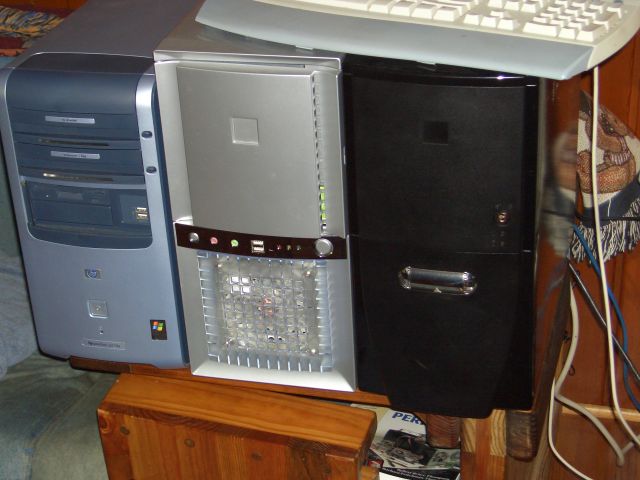
When I needed a Windows XP machine to do some screen shots, I
temporarily installed another system in the den, put XP on it, and shot
the screen captures. This image is from a week or so ago, when I had Al
and Frances's HP Pavilion PC (far left) over here to configure Xandros
and troubleshoot some problems. The middle machine is my temporary
Windows XP box, in an Antec Super LANBoy case, and the machine on the
right is my permanent--as much as machines around here are ever
"permanent"--Xandros den system, in an Antec Sonata case. (Looking at
this image reminds me that I need to get some little square Tux penguin
logos to affix to the empty squares on the Antec cases.)
Last night, I'd about had it with Windows XP. I really dislike using
it, and found myself longing for Xandros. When I installed XP on the
aluminum box, I'd told it to take the entire hard drive. Being an
original XP distribution disk without SP1, it used only 128 GB of the
160 GB drive, but that's another story. I'd never installed Xandros
dual-boot, so I decided to give it a try.
I stuck the Xandros 2.5 disc in the DVD drive, and up popped a message
telling me to click OK and reboot the system to install Xandros. I did
that, and everything worked flawlessly. Xandros detected the XP
installation and asked me how I wanted to handle the partitioning. By
default, Xandros offered to shrink the NTFS partition and take half the
space for itself. I told it to go ahead. It warned me that the resizing
process might take several hours, especially if the NTFS partition was
badly fragmented. As it turned out, with a relatively fresh XP
installation, resizing took only a few minutes. When resizing was
complete, Xandros installed itself normally and installed a boot
manager. Now, when I boot the system, the Xandros splash screen
appears, with "Windows XP" as option #4.
I don't know for sure about others, but I suspect we all go through a
similar process when we change something significant. For example, when
I stopped using Outlook and IE and started using Mozilla for browsing
and email, I went through something like the following:
- I HATE THIS
- I hate this
- I don't much like this
- I can live with this, but I sure miss the old stuff
- This isn't too bad
- I kind of like this
- I really like this
- How did I ever put up with that old crap
With Mozilla, as I recall, I got past steps 1 through 3 in a day, steps
4 through 6 in less than a week, and up to step 8 within a couple
weeks. What was remarkable about migrating to Xandros is that I never
experienced steps 1 through 6 at all. I started immediately at step 7,
and got to step 8 within a couple of days.
What's interesting about Windows XP is that for me the sequence starts
in the middle and works backward. Every time I install XP, I start
using it around step 4. Before long, I'm down to step 3, and inevitably
something happens, like a pop-up prompt to activate, that drops me to
step 2, and then eventually to step 1. None of this happens with
Windows 2000, incidentally.
Since I need Windows XP to do screen shots for the books, I'm condemned
to running it on at least one system. It's unclear to me how the 60-day
activation countdown works. It may be that Setup generates a polynomial
key that embeds the first-run date/time. If that's the case, imaging
the XP partition and restoring it periodically won't help me avoid the
60-day deadline. It may be that I can set the PC clock/calendar back a
year or so, install XP, and have a year-and-60-days left to run it,
although I'd be surprised if that worked. Or it may be that I can
simply reset the clock/calendar on the existing installation to a date
within the 60-day window. If worse comes to worst, I can simply
reinstall XP fresh a couple of times to keep a working system available
for screenshots. But the mere fact that I even have to think about this
is enough reason for me never to use XP for a production system.
In fact, I'm going to blow away my Windows 2000 installation on the PVR
system and install Linux with MythPC. Before long, the only production
systems I'll have running Windows are my Windows 2000 notebook system
and perhaps a Windows partition for gaming on my primary system.
13:58 - There
are a lot of people who read this page every day but never read the
messageboard. That's a shame, because a lot of interesting discussion
goes on over there. For example, the following exchange begins with Roy
Harvey quoting something I'd written that my father told me when I was
small.
Quote (Roy Harvey @ Sep. 24 2004,11:16)
"Honest
people, he said, assume that everyone else is also honest. Dishonest
people assume that everyone else is also dishonest."
Nice saying. 8-)
Then again, when you think about it, it says that both honest and dishonest people are demonstrably stupid.
No, not stupid, but merely with a certain certain filter on how they
look at other people. Honest people certainly know that there are
dishonest people in the world, and vice versa, but there's a strong
human need to believe that most people are pretty much like you. Or,
turning it on its head, that you're pretty much normal. If you're
honest, you therefore assume that's "normal", and that most other
people are pretty honest. Conversely, if you're dishonest, you assume
that's normal and most other people are also pretty dishonest.
Also note that people have built-in moral compasses. They're not born
with them, but they learn as children the concepts of right and wrong,
and they tend to follow their own compasses regardless of what the law
says. That's why most people ignore speed limits unless there's a good
chance of getting caught.
That's also why people knock off copies of CDs or software and give
them to their friends. As illegal as that may (or may not) be, the vast
majority of people don't perceive it as wrong. And when the law and
people's perceptions differ so widely, the law is in trouble.
Ask yourself this. Would you go into a store and shoplift an audio CD
or a software package? No, I thought not. But would you knock off a
copy of an audio CD or software package? Yep, I thought so.
The reason is that the first is theft, which the vast majority of us
believe is wrong. You've deprived the store of a tangible object, and
they have to take a monetary loss on it. In the second case, you
haven't stolen anything. The store still has its CD and hasn't taken
any monetary loss. Neither has anyone else. You have infringed
copyright, which is a much squishier concept.
Here's what my moral compass says: it's wrong to shoplift the CD; it's
okay to knock off a copy of it and give it to a friend; it's not okay
to start making large numbers of duplicates and sell them for profit.
In other words, I have no problem at all with non-commercial copyright
infringement. That also means I think the original Napster and other
peer sharing arrangements are fine, as long as no money changes hands.
And, with the possible exception of the last item (which does follow
logically from the others), I think the vast majority of people agree
with me completely.
People who disagree are mostly hypocrites and liars. Whenever I
encounter someone who maintains that non-commercial copyright
infringement is wrong (as opposed to illegal), I always ask him two
questions: (a) have you ever copied anything and given it to a friend,
and (b) have you ever accepted a copy from a friend? Every once in a
great while someone answers "no" to both questions, in which case I
assume he's either a liar or a candidate for sainthood. But nearly
everyone has given or accepted copies from time to time, and that in my
mind makes them hypocrites if they take a stand against non-commercial
copying.
Of course, honesty does have its limits. I encountered that when I was
talking to the State Farm corporate guy up in Charlottesville, Virginia
about a claim for our roof. I expected him to tell me to get two or
three quotes for having the roof replaced and that they'd pay the
lowest of the quotes less our deductible.
He said they didn't do things that way anymore. Instead, they determine
how much they'll pay based on the size of the roof and the prevailing
rates in the local area. He said they'd pay about $3,300 total. I asked
if that included the reduction for our deductible, and he said it did;
that they figured the actual cost to replace the roof would be about
$3,550, so they'd pay that less our $250 deductible.
As it happened, we'd just gotten a statement that detailed our
insurance coverage, and I was sure it said we had a $500 deductible. So
I told the guy I thought our deductible was $500 rather than $250. He
looked at his screen again, and said, "No. It's $250." I told him that
I'd just gotten a statement that said our deductible was $500. He said,
"Let me check again," and put me on hold for a couple minutes. He came
back and said, "Nope. Your deductible is $250. You must have been
looking at some other number on the statement."
Numbers are my friends, and I don't usually make mistakes with them.
That's an understatement. In fact, the last time I made a mistake with
a number was, I think, in 1969. But the State Farm guy seemed so sure
that I went and looked again. Sure enough, the statement says our
deductible is $500.
So, I suppose if I were Abe-Lincoln-honest, I'd walk miles to return
the extra penny, or at least send them a copy of our statement with the
deductible number highlighted. But I tried, more than once, to call
their attention to their error in our favor, and they insisted I was
wrong. So I let it drop.
[Top]
Saturday, 25 September 2004
[Last Week]
[Monday] [Tuesday]
[Wednesday] [Thursday] [Friday]
[Saturday] [Sunday] [Next Week]
[Daynotes Journal Forums] [HardwareGuys.com
Forums] [TechnoMayhem.com Forums]
{Five Years
Ago Today]
12:41 -
Barbara left this morning on a bus tour to Vermont with her parents.
Actually, she left last night, to stay overnight at her parents' house
because they had to leave about 4:45 a.m. to drive over to Randleman,
North Carolina, where the bus departed at 6:00 a.m. this morning.
She left me with lots of deli food and frozen dinners, so I should be
okay until she returns on Thursday night. She counted the dogs before
she left, so I'll have to remember to give them food and water while
she's gone.
I like to coin at least one or two new words a year. Eventually, one of
them may end up in the OED. Actually, one already has. Back in the
mid-80's, I was the person who coined the term "coaster" for a CD that
was ruined during burning. I was watching my friend John Mikol burn his
first CD. The CD burner cost something like $25,000, and each
blank CD cost $50. As I watched his first attempt to burn a CD fail, I said to John, "Way to
go, John. You just made a $50 coaster." I used the same term on the USENET,
back when I was still using various bang (UUCP) addresses, and the term
later became common. So I'm claiming it.
At any rate, it occurred to me that we need a new word to describe the
process of migrating from legacy Windows operating systems to modern
operating systems like Linux. Defenestration, after the Latin fenestra for window, is defined as the act of throwing someone or something out a window, so I came up with the following:
fenestrajection: The act of throwing Windows out.
I just did a Google search to verify that the word is original:
Your search - fenestrajection - did not match any documents.
No pages were found containing "fenestrajection".
Let's see how long it take to hit Google, how many sites pick it up, and how many hits it eventually provides.
And now I'd better get to work. I have a system to build and some fenestrajection to do.
[Top]
Sunday, 26 September 2004
[Last Week]
[Monday] [Tuesday]
[Wednesday] [Thursday] [Friday]
[Saturday] [Sunday] [Next Week]
[Daynotes Journal Forums] [HardwareGuys.com
Forums] [TechnoMayhem.com Forums]
{Five Years
Ago Today]
[Top]
Copyright © 1998, 1999, 2000, 2001, 2002, 2003, 2004 by Robert Bruce Thompson. All Rights Reserved.